

What “Made with AI” Actually Warns You About
Zinstrel #088 · Guest Column · AI Music News & Analysis
While Editor Marcus Lawrence is traveling, guest voices are stepping in to keep the AI music conversation going. Today’s post comes from AI artist Itai Leibowitz, known as I+AI — a musician, writer, former SSC winner, AI Music Embassy leader, and founder of Vibya, a platform built to connect people through their music — with part one of two on why “made with AI” fails as a label.
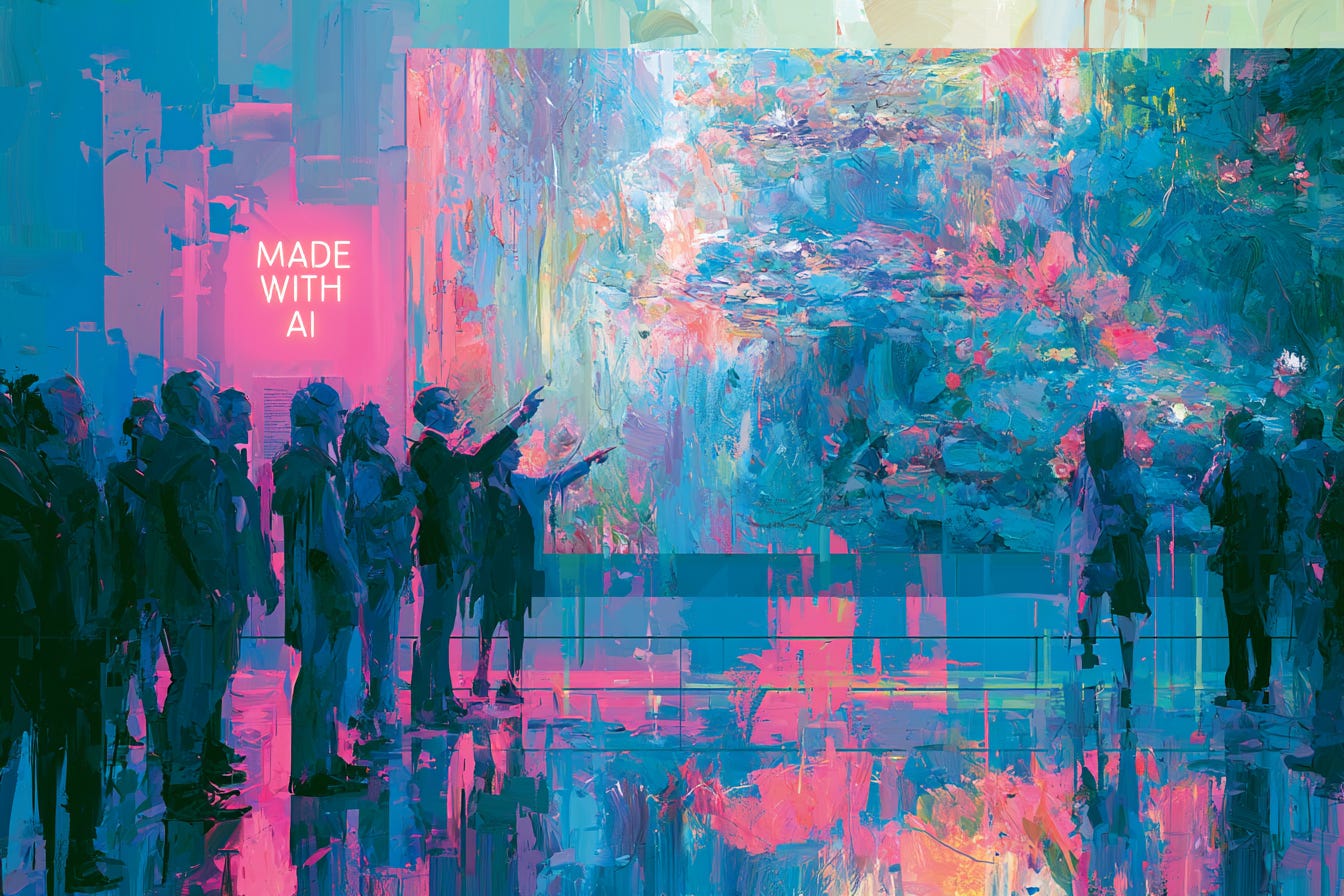
In May, the artist @Shl0ms ran an experiment on X. He cropped a painting, posted it, added a “Made with AI” label, and asked: “Tell me, in detail, what makes this inferior to a real Monet?”
People lined up to comment.
“It lacks the mess of humanity.”
“It doesn’t make me feel anything.”
One person explained that the light on the water was all wrong, because “Monet actually understood how light behaves.”
Another just wrote “no talent. AI needs to go.”
Turns out, it was a real Monet. One of the Water Lilies, from his own garden, painted during the last decades of his life. When that came out, a lot of the replies quietly disappeared.
There’s even research on this now: a 2023 iScience study found that people showed a negative bias against artworks they believed were AI-made. The label made it appear to be worth less.
I’ve been chewing on this for a while, and just recently there was another development in the “made with AI” story with real consequences. Tidal announced that, starting July 15, it will detect music it deems “fully AI-generated,” stamp it with an AI badge, make it ineligible for royalties, and block it from direct-to-fan sales.
They were careful to say it isn’t a ban. Just no pay. And they called the policy a “living document,” which means the rules will keep changing.
I make music and a lot of other things with AI, and I have faced every unpleasant flavor of this label. In comments, in being banned, and even to my face in meetings with music industry folks who find me interesting right up until “AI” comes up.
So I want to try to tease apart a few strands from the “made with AI” blob. Because I think it’s important to call things what they are and point out what works and what misses the point entirely.
There are four main strands I want to pull apart. I’ll take the first two here — what the label actually warns you about, and what AI detection actually detects — and come back to the other two in Part 2.
1. “Made with AI” is a poor replacement for better labels.
When people say “artificial” they mean “not real.” But ‘real’ also means so many things, so it’s worth noticing that what “artificial” means depends on what it aims to be in the first place.
When it pretends to be a fact
Sometimes a thing pretends to be a fact — a photo of something that happened, a quote that someone important said. The danger there is being lied to, and it’s serious. AI makes it easy to fake stuff. But I can easily use Google Docs to put a fake quote under a real photo of any politician.
The more accurate label for that is “this didn’t really happen,” and the Google Docs version deserves that label just as much as anything made with AI.
When it pretends to be a person
Sometimes a thing pretends to be a person — their face, their voice. The danger is consent, rights, or stolen identity, from Taylor Swift selling pans she never saw, to someone cloning my voice to call my bank.
The honest label is “this isn’t me.” That’s the specific thing the NO FAKES Act is reaching for, and regardless of how it is actually written and its gaps, it at least seems to focus on the specific issue of deepfakes like this.
When it pretends to be expertise
Sometimes a thing pretends to be expertise — confident, qualified, correct. The lawyer who filed a brief full of cases his chatbot made up. A medical answer from ChatGPT with a suggested treatment. The danger is trusting it and getting hurt.
A good tag there would be “Double-check this.” And we should recognize that humans make mistakes too, a lot. Here’s a nice study showing how 120+ dentists shown the same series of X-rays came up with wide-ranging diagnoses and treatment plans between $300 and $36k. So sometimes a second opinion is a good idea, even without AI.
When it pretends to be nothing at all
And then there’s the creative stuff, which usually pretends to be nothing at all. A song. A painting. A character I made up named Dear Gabrielle who gives sassy life advice and has never once claimed to be your doctor or priest. No facts to check, no person to fake, no expert advice waiting for you.
So what is the “AI” label warning you about? Nothing. It just tells you to feel less.
It’s worth recognizing how much “AI” is already everywhere: think about any video, any ad, any show you watched this week. AI was somewhere in it — the idea, the effects, the upscale, the color, a background, a fix. “Substantially made with AI” will soon describe almost everything, which is another way of saying it describes nothing.
Because the point of using tools in the creative space was never “look, a robot did it.” The point is that it let somebody make the thing in the first place — faster, braver, weirder, better than they could alone. That’s what AI enables in a creative process. A label that treats that as a warning sign has the whole purpose backward.

2. Detection labels a tool, and the tool is one ingredient
Tidal’s plan, like many others, leans on detection. Detection is at the lazy center of much of this, because the only thing it can ever find is a tool. And a tool is one ingredient in a long process with many tools.
It’s like stamping a song “made with a synthesizer.” Or flagging this essay because I ran it past a spell-checker. Or putting a sticker on my key lime pie that says “made with condensed milk.” If the pie is good, the condensed milk is not a risk, it’s a recipe.
At the risk of over-baking this analogy… detection looks at the kitchen, not the food. It finds the can of condensed milk and tells you nothing about whether the pie is any good.
That’s the first half of the problem: the label is imprecise, and detection only ever catches the tool.
In Part 2, I’ll pick up the other two strands — what the label quietly costs you once it’s attached, and the worst version of all, when it stops describing the work and starts describing the person.
🎧 Song of the Day: “Love Me” by RaVeN
A dreamy, hypnotic deep house track perfect for sun-drenched days, blending repetitive, soulful vocal hooks with lush, tropical soundscapes.
💬 Last Word
“Everyone says AI is changing music. But maybe AI is just exposing a much bigger question: Where is music’s value actually created?”
— Rock Paper Scissors CEO & Music Tectonics Founder Dmitry Vietze, via LinkedIn

MORE ZINSTREL:
Zinstrel.com | @zinstrel_ai on IG | AI Underground on Discord
Copyright 2026 Zinstrel, LLC - All rights reserved
Written by Marcus Lawrence, courtesy of composition platform Versey.ai
Special thanks to our paid subscribers: C.Y. Lee, Daryl Dekking, Lynn Clapp, Steve Clapp, Mete Dibi, Daniel Lares, Dexter Garcia, Matthew Marturano, Sammy Stoltz, Tim Burley, Drew Thurlow, Sheila Spence, Lenny Skolnik, Màuhan Zonoozy, Matti Kuha, Jacci Cenci-McGrody, and Jonathan Barrios.
A big part of the reason they are pushing for labeling is because they are simultaneously investing heavily in AI, and they want a way to avoid training their investment AI on AI content, which results in worse and worse outputs, like a photocopy of a photocopy. Anyone who says its to prevent deception or to protect artists is delusional. Money is all that matters to them in this discussion. Nothing more.