

TIDAL Says Fully AI-Generated Music Won't Earn Royalties
Zinstrel #081 · Signals · AI Music News & Analysis

TIDAL is about to take a step no other music streaming platform has yet taken: cutting off monetization entirely for fully AI-generated music. And it’s just getting started.
Starting July 15, 2026, the platform will deny royalties and tipping and direct fan payments to any release it classifies as wholly AI-generated. These tracks will get a visible AI label. Impersonations get removed.
Why this stands out is that it’s making a commercial judgment. Other DSPs have built AI policy around fraud, transparency, or copyright. TIDAL is building it around monetization. Fully machine-made music simply won’t be paid.
The scale explains the urgency. Deezer reported in April that 44% of all new music delivered to its platform — roughly 75,000 tracks a day — was fully AI-generated. TIDAL, although they haven’t disclosed actual numbers, has described its own daily intake as “overwhelming.”
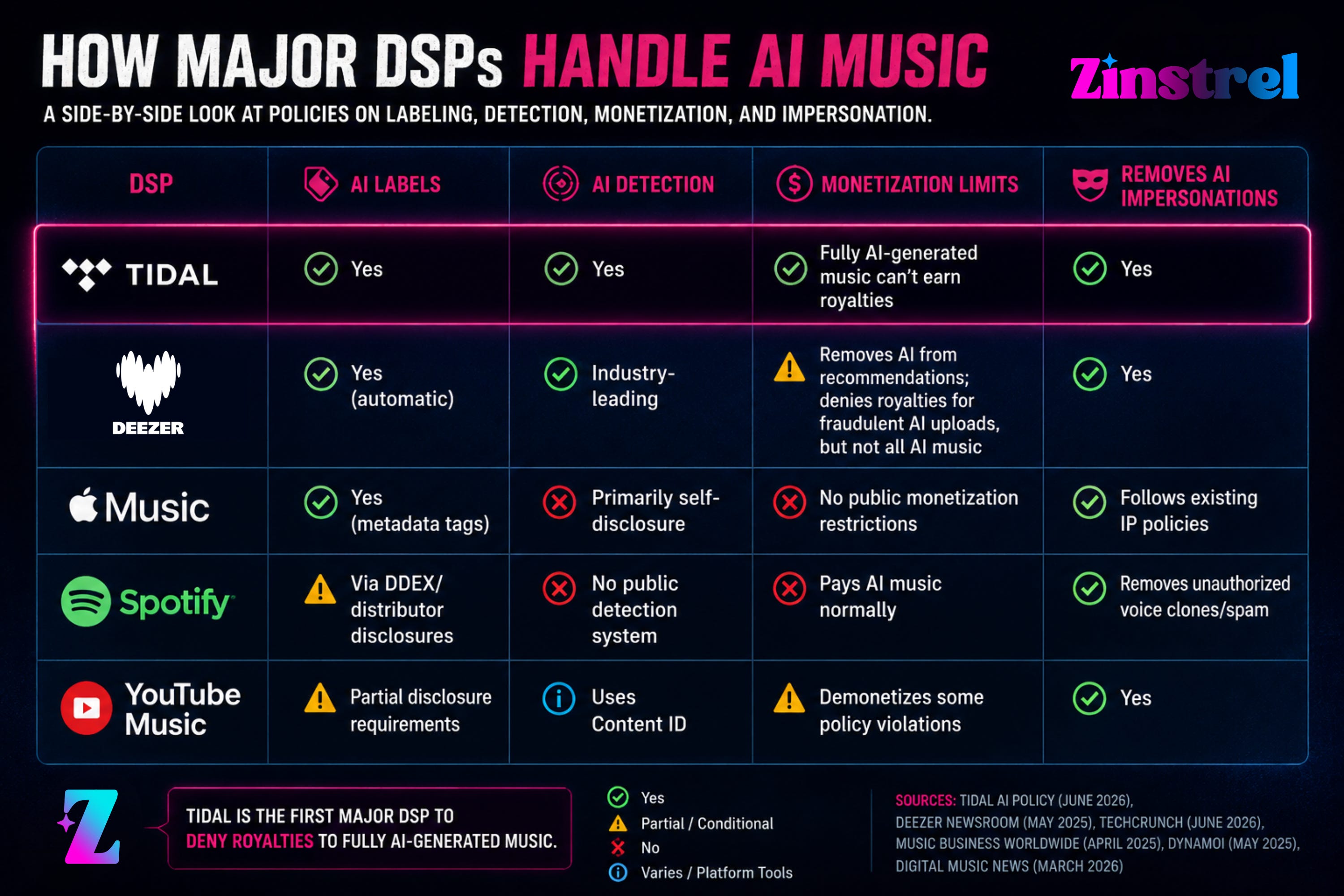
TIDAL’s policy further illustrates a sharp contrast across the industry regarding how AI music is handled. Deezer focuses on fraud, stripping AI tracks from recommendations and royalty calculations when tied to streaming abuse, but otherwise allowing AI music on the platform. Apple Music relies on self-disclosure but doesn’t demonetize AI music. Spotify pays AI music normally — although there is some debate over whether Spotify is deplatforming AI artists. TIDAL’s policy reaches further: fraud or not, wholly AI-generated music doesn’t earn.
The big question — and potential problem — is where the line gets drawn. According to the Sonic Intelligence Academy’s Q1 2026 AI Music Intelligence Report, 90.4% of serious charted AI music creators use Suno — but only 19% classify their work as fully AI-generated. The remaining 81% are working in AI-assisted or Human + AI Hybrid modes. TIDAL’s policy exempts them — for now. The platform has explicitly signaled it will expand enforcement to “substantially” AI-generated music as detection improves. What that threshold looks like, and who defines it, remains an open question.
Meanwhile, AI music platforms are actively building alternatives themselves. AI music DSP Souna has signaled plans to build monetization tools specifically for AI artists that go beyond its existing tip jar system. ElevenLabs launched its Music Marketplace in March, and is already paying creators from a model that has distributed more than $11 million to voice creators.
Whether the major DSPs or the AI-native platforms define how AI music gets paid is now one of the bigger open questions in the space.
Editor’s Take: Generally speaking, there’s nothing wrong with Tidal’s decision to crack down on fully AI-generated songs. But it needs to be forthcoming with its definition of AI-generated. Additionally, if a song has the label and is demonetized from the streaming pool, why is Tidal preventing fans from tipping these artists? If they have all the information and want to financially support a song, why is Tidal stopping them?
LAUNCH SIGNALS
Suno Launches Artist Incubator — With Strings Attached
Suno has unveiled Spark, an incubator program offering independent artists grants, mentorship, writing camp access, and marketing support — while artists retain full creative ownership. But the fine print runs deeper: participants face a 60-day exclusivity clause barring paid work with competing AI music companies, must submit all content for Suno approval before posting, and sign a “Good Vibes Only” clause prohibiting disparagement of the platform during and forever after their term. There’s a lot that’s still unknown about the program, including its exact amounts of support, and how these would be distributed. We’ll be watching to see who signs on.
A Researcher Is Building What AI Sheet Music Needs
Computational scientist Leah Childers has published early details on Neurallegro, a music notation tokenizer she designed from scratch to address a gap she sees in AI tooling for composers. Unlike audio-focused models, notation AI has to capture how music is actually written: the relationships between instruments, the dynamics, the articulations, all the small marks that tell a performer what to do. Existing formats like MusicXML and MIDI struggle with that. Childers says her tokenizer achieves a vocabulary of 628 tokens while outperforming existing formats on both compactness and semantic fidelity, with a GitHub release and first transformer training run coming soon.
Riffle Adds Voice Control to Its AI Music Assistant
Collaborative music creation platform Riffle has launched Voice Mode for Sous Chef, its AI production assistant, letting creators build and edit tracks through natural-language voice commands rather than typed prompts. It's a meaningful evolution for a tool that launched earlier this year only able to suggest samples and chat about a track — what the team described as a sous chef who could recommend ingredients but wasn't allowed to touch the stove.
Now it can cook: in a demo, users generated drum patterns, added instrumentation, applied effects, and adjusted mix levels entirely by speaking, with every action undoable. The update signals something broader — the prompt box may not be the future of AI music creation.
LEGAL SIGNALS
Backstreet Boys Move to Trademark Their Voices
The Backstreet Boys are pursuing trademark protection for the sound of their voices, the latest in a rapidly accelerating wave of artists treating vocal identity as a distinct, protectable asset. Taylor Swift filed similar applications in late April, covering her voice and stage image, and Matthew McConaughey secured eight voice-and-likeness trademarks in January 2026, framing the strategy as building “a clear perimeter around ownership” in an AI world.
The legal infrastructure is catching up: the NO FAKES Act, which would create a federal DMCA-style notice-and-takedown system for unauthorized AI voice replicas, passed unanimously out of the Senate Judiciary Committee on June 18.
Independent Artists’ Case Against Suno and Udio Adds Major Law Firm
Hagens Berman — the law firm behind the landmark $260 billion Big Tobacco settlement in 1998, now the largest litigation recovery in US history — has joined the independent-artist class action against Suno and Udio, filing an amended complaint in New York on June 22.
The case, originally brought by country trucking artist Tony Justice and his label 5th Wheel Records in June 2025, now counts nearly 1,300 creators behind it — including influential music critic Anthony Fantano, and Benn Jordan, an electronic producer who has become one of AI ethics’ most outspoken voices.
The amended complaint’s central allegation is stream-ripping: that both companies used software to circumvent the technological protections on YouTube and Spotify to download audio for training — a potential DMCA anti-circumvention violation on top of standard copyright infringement claims, and one a federal court already declined to dismiss against Udio in May. This case is separate from the major-label suits, where Sony is suing both companies and Universal is suing Suno. Hagens Berman’s involvement brings serious legal firepower, and a track record of winning at scale, to the only case positioned to deliver meaningful financial relief to independent artists.
‘Sleeping Disco’ Dataset Deleted After Copyright Exposure
The AI music training dataset "Sleeping Disco" was abruptly decommissioned after The Atlantic AI Watch Dog published findings showing it contained copyrighted music — allowing artists to search and find their own recordings within it. The founder deleted all associated GitHub records the following day. The people behind it now claim it was "strictly a metadata repository" with no generative models ever trained on it — a defense that might carry more weight if they hadn't deleted everything the moment anyone started looking.
Jamendo Sues Nvidia Over AI Training Data
Royalty-free music platform Jamendo has sued Nvidia in California federal court, alleging the chip giant used its catalog of 55,000 songs — assembled with a Spanish university for academic research use — to train two AI models: Fugatto, a generative music tool Nvidia described as a “Swiss Army knife for sound,” and Audio Flamingo, an AI model designed to analyze and describe audio.
Nvidia’s own public statements identify the MTG-Jamendo Dataset as one of the sources used — and Jamendo argues that its carefully curated catalog, complete with metadata and tagging frameworks, is itself a copyrighted work with distinct commercial value that Nvidia exploited without payment.
The lawsuit is structurally different from the Suno and Udio cases: Jamendo already licenses its music and datasets for AI and machine-learning uses, which could make the market-harm argument easier to prove, because Nvidia used the data for exactly the kind of commercial purpose Jamendo sells licenses for. Jamendo is seeking an injunction plus damages of no less than €17.8 million (~$20.3 million).
🎧 Song of the Day: “I Keep Holding On” by MIMILOVE
Rom-com climactic scene energy propels this heartfelt, cinematic pop single from Mimilove.
💬 Last Word
“[S]taying comfortable with evolving workflows is critical. Even if it’s not adding huge value today, I’m convinced that future tweaks (or competing platforms) will make [AI] tools like this essential.”
— Artist and Entrepreneur Arjun Kanungo, via LinkedIn

MORE ZINSTREL:
Zinstrel.com | @zinstrel_ai on IG | AI Underground on Discord
Copyright 2026 Zinstrel, LLC - All rights reserved
Written by Marcus Lawrence, courtesy of composition platform Versey.ai
Special thanks to our paid subscribers: C.Y. Lee, Daryl Dekking, Lynn Clapp, Steve Clapp, Mete Dibi, Daniel Lares, Dexter Garcia, Matthew Marturano, Sammy Stoltz, Tim Burley, Drew Thurlow, Sheila Spence, Lenny Skolnik, Màuhan Zonoozy, and Matti Kuha.
Classifying something based on the tools used is lazy and shortsighted. 'we will now ban anything made with a synthesizer' is clearly silly. Totally their right to do it in their store. But I have a lot to say about this.. hey maybe I'll write something ☺️
The issue with banning wholly-AI-generated music ... how do they know for certain that a track falls into this category? It would be nice if there was some service that an artist could submit their song to before trying to distribute it, that would tell them whether or not any given platform will accept their song and monetize it.
I understand platforms wanting to halt the influx of tracks from AI bot farms. Such tracks could eventually overburden a system. But I can envision an independent human artist spending hours, days, or even weeks on a track and it still not passing an AI check. I don't see how any attempt to measure human involvement after the track is finalized can possibly take into account what all the human did prior to finalizing the track.
If only there were a way to embed within the audio for a song some code that could track certain actions taken on that song. Then an artist could have proof of some degree of human involvement for a track. Any track without such a code could be submitted to the AI detectors. It would be nice if such a code could survive stem separation. I don't know... It would take brighter minds than mine to come up with a system like that, but I'm sure there are plenty bright minds out there that could work on this if it might be useful.