


On a stage in Zurich, Switzerland, there was nothing particularly special about the way the band Auditory Nerve played its song at the 2024 AI Song Contest finals. No prompt boxes, no robots on guitar, no technology doing anything at all as the group — four students and two professors from the University of Miami’s Frost School of Music — performed its original material.
Make no mistake, AI was involved. But you might not have known it had you walked in after the band explained how the song got made.
“We basically played what we created by using AI,” says Raina Murnak, the band’s vocalist and one of the two Miami professors (the other being her frequent collaborator Dr. Tom Collins). “We weren’t processing things in real time. We used the AI as the co-writer, and then we performed them live as anybody would perform any song.”
The performance was the straightforward part. Harder was the account that had to come with it — telling a concert audience which decisions had been the machine’s, and why that belonged on the program, “without it being too academic.”
Murnak’s caution wasn’t misplaced. Unlike many other song contests in the AI space, where you simply upload an audio file, entering the AI Song Contest means writing a detailed paper explaining how AI participated in the creative process.
The oldest international competition for human-AI co-created music does not accept a song as evidence of anything on its own.
That requirement has produced some of the most inventive music in the field. It has also made the contest a self-selecting one, because the people who enter are willing to show their work.
It started as an evaluation problem
The AI Song Contest didn’t begin as a music competition but rather as a research question.
After the Netherlands won the Eurovision Song Contest in 2019, Dutch broadcaster VPRO began developing ideas around the following year’s contest. Programme creator Karen van Dijk proposed a stranger one: teams would compose songs using AI, and judges would assess not just the track but how the technology had been used.
Nobody knew how to score that.
“So she drew two or three people from the community to help build the scoring rubric and be judges for the first year,” says Ryan Groves, a longtime organizer and current board member and judge. “It came from a very scientifically rigorous place.”
She recruited researchers from ISMIR, the academic community around music information retrieval, to build the first rubric. They created questions that made teams document how AI entered their workflow, then later analyzed those responses as research.
The paperwork existed before the songs did.
VPRO handed the competition to an independent nonprofit after the first year, but the rubric stayed. Today, about half the jury are music technology professors, giving the contest a distinctly academic feel.
The paperwork is the rule
Entrants are required to complete a Process Document as part of their submissions. It’s made up of five sections, roughly 250 words each, circling the same question: what did the AI actually do here, and what did you do?
They explain their motivation, creative vision and workflow, including how the tools changed their original plan. Then they document where the AI failed, how they evaluated its output, and how training data, authorship, ownership and cultural bias affected the result.
“We’re actually asking them to report on every single model they used, how it impacted their creativity, what their original vision was, what different parts of the song they used it for,” Groves says. “It’s not just the song.”
Prompt-to-song-only entries are disqualified — full stop. That rule went in after submissions jumped from 65 to 155 in a single year, when many of the new entrants assumed “AI Song Contest” meant generating a song and sending it in.
“People still think, oh, it’s an AI song contest, so I just have to prompt something,” Groves says.
The contest strongly recommends against Suno and Udio, citing both companies’ pending litigation, and points entrants toward tools it considers fair. Murky provenance isn’t an automatic disqualification, Groves says, but notes “it’s going to be very hard to succeed in our contest.”
What entrants actually do
Strip out the prompters and what’s left is stranger and more creative than AI music usually gets credit for.
Nikki, a Buenos Aires-born visual artist and producer with roots in Okinawa, spent months giving an inflatable doll a voice. Her 2025 entry, “Thanks for Being Lifeless,” grew out of that experiment.
She trained eight experimental models on recordings of herself singing, speaking and whispering across Spanish, Japanese and English, deliberately embracing messy datasets, obsolete models, glitches and collapses rather than chasing a convincing clone.
The point became less about making a machine imitate her than discovering what emerged when her voice passed through “the ghosts of obsolete datasets and unstable models.”
Jack Loth and Pedro Sarmento took another route. Their metal project HEL9000 went hunting for “noisy/bad data,” including feeding a YouTube recording of an explosion through a singing voice-conversion model.
Alone, the result sounded terrible. Mixed underneath the lead vocal, it worked like an artificial double.
The rest, they wrote, was composed and mixed like a standard metal song.
Murnak also runs toward creative voice production — specifically tone transfer, where models trained across different singers can produce a third voice belonging completely to neither.
“AI becomes this character in the storyline of the creation of the song,” she says. “What are some creative things that we can only do because of this character?”
After two years with Auditory Nerve, she’s entering again with a new team. To Zinstrel, she only describes the project in outline — a model trained across repeated takes of her own performance until it settles toward a deliberately averaged middle, then pushed against with tone transfer — because she wants to save the rest for the document.
Which is its own kind of endorsement.
The most interesting thing she’ll make this year may be the paperwork behind her song, and most people will never even open it.
Who it asks for
Murnak doesn’t pretend the AI Song Contest is for everyone. It selects for a particular kind of musician — one interested in understanding the technology shaping the sounds as deeply as the lyrics or melody.
She says popular music doesn’t have much connection with academia, and that’ll make this tricky for a lot of creators.
“Let’s be honest; forcing songwriting down the path of thesis defense is definitely going to immediately take people out of the running,” she says. “They’re not going to be interested in doing it that way. They don’t have the experience in documenting things in that manner.”
And then, in the same breath: “That document is so important to understand the process.”
Despite all the work, the public vote doesn’t turn on any of it. The contest publishes the process documents, but nothing requires a listener to read one before voting.
Half the result is jury scoring, statistically normalized to account for strict and generous judges.
“Sometimes judges tend to be in one region of scoring,” Groves says. “A 10 from one judge could be like a 6 from another.”
The other half is just people listening. Auditory Nerve’s own record bears it out — seventh in Zurich in 2024, then back the next year in Amsterdam, where “Silent N(AI)ght” finished second in the public vote and third overall.
A song can win the room and place differently with the rubric, which is what happens when a research instrument and a music competition share one stage.
The contest’s position is that the high standard of entry is the point.
Plenty of places will take an mp3. This is the one that can tell you why the mp3 sounds the way it does.
What it produces
The clearest evidence the bet pays is Yaboi Hanoi. A Google Magenta researcher when he entered in 2022, he fused traditional Thai instrumentation with Western dance music, including pitch-shifting a Thai oboe until it sat naturally inside an EDM track.
He won. He has since left research to become a full-time musician.
“He’s part of the reason we’re doing the final in Bangkok this year,” Groves says.
The contest changed Groves’ trajectory, too. Last year he left day-to-day organizing for the World Intellectual Property Organization, where he now works on AI and copyright policy.
“All of this AI song contest stuff was hyper-relevant for them,” he says.
A contest that began by asking “how do we evaluate this?” gave one of its organizers several years of practice asking the same question before he took it to the policy level.
Identical-looking audio files can represent radically different kinds of human work. That’s the problem the contest was built around in 2020, years before generative AI made the question urgent across the music industry. It’s why the paperwork keeps getting more demanding rather than less.
A song plus an honest account of how it was made is a different object than a song alone. The contest asks more of the people who enter, and it asks for a particular kind of musician — one curious enough about their own process to sit down and write it out.
Murnak thinks the demand is steep.
And she is preparing her third entry.
The 2026 AI Song Contest is open for submissions through Sept. 27, with the award show in Bangkok on Nov. 29. The winner takes $1,000 and a trip to the show. Enter at www.aisongcontest.com.
💿 SIQA Top AI Songs of the Week
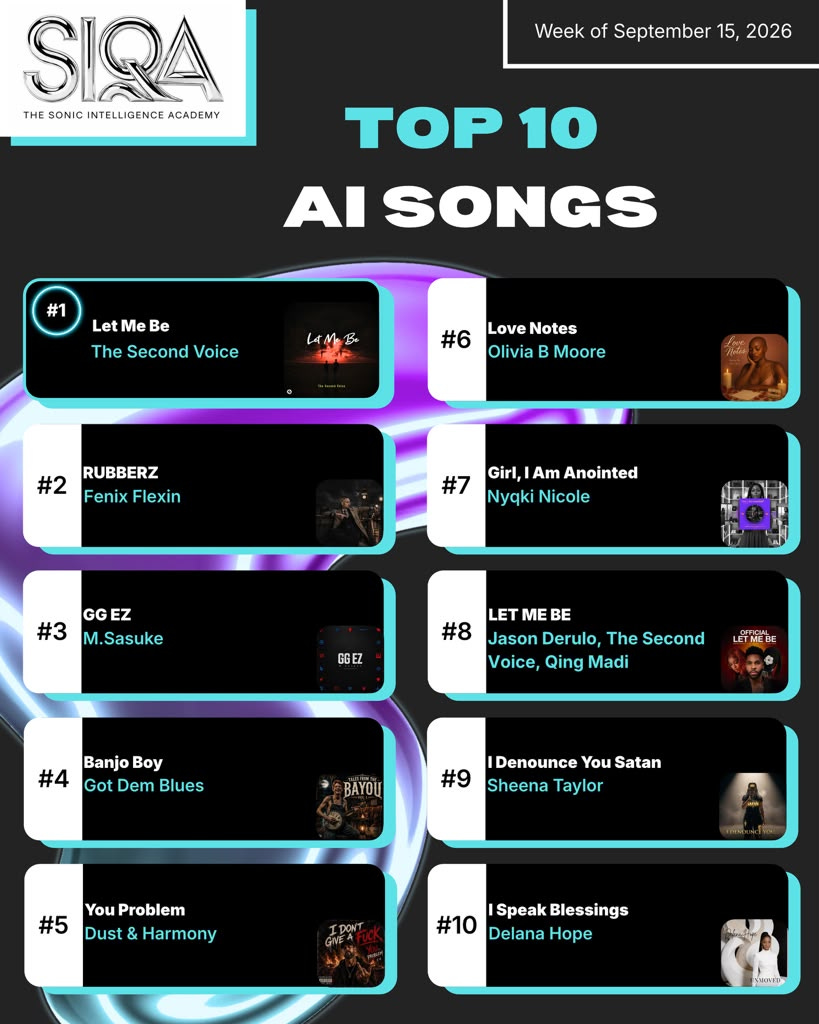
The chart was remarkably stable week over week, with nine of last week’s Top 10 still present and the entire Top 3 unchanged. The big story is “Let Me Be” now occupying two spots: The Second Voice’s original remains at No. 1, while the new Jason Derulo / The Second Voice / Qinq Madi version debuts at No. 8.
🎧 Song of the Day: “facedown” by Angelbaby & Arrested Youth
A bruised, melodic breakup track that pairs angelbaby’s virtual-pop sheen with Arrested Youth’s rawer edge — another reminder that the line between virtual artist and conventional pop act is getting harder to see.
💬 Last Word
“So much of growth requires being willing to look a little awkward, care a little too much, try something before you know you’ll be good at it, and risk being misunderstood.”
— Music Journalist Allison Hagendorf, via Substack

Zinstrel: AI Music News & Discovery is a 3x/week publication covering the tools, culture, and power shifts shaping AI music. Subscribe to stay in the loop — free or paid.
MORE ZINSTREL:
Zinstrel.com | @zinstrelculture on IG | AI Underground on Discord
Copyright 2026 Zinstrel, LLC - All rights reserved
Zinstrel #112: The Suno-ElevenLabs Rivalry Is in Full Swing
Zinstrel #111: Suno Is Launching v6 Into a Worsening Legal Storm
Created by Marcus Lawrence
Copyright 2025-2026 Zinstrel, LLC - All rights reserved
Special thanks to our paid subscribers: Blue Hermit, Bukar Gadzama, C.Y. Lee, Charles S, Chez, Daniel Drolet, Daryl Dekking, Dave, Dexter Garcia, Drew Thurlow, Ghost Ryder, Itai Leibowitz, Jacci Cenci-McGrody, Lenny Skolnik, Lynn Clapp, Marc Wolinsky, Matthew Marturano, Matti Kuha, Mete Dibi, Rosanna, Sheila Spence, Steve Clapp, Steve Grossman, and Tim Burley.
Merci de nous avoir fait découvrir cet AI Song Contest, son format et son règlement sont extrêmement intéressants. Encore une iniative étonnante dans le domaine bouillonnant de la musique par IA !