



The rivalry between Suno and ElevenLabs has gone beyond competition for who has the better AI audio tech. It’s now about who can lock up the music industry first.
Suno and ElevenLabs both made moves this week that point toward the same target: licensed access to major-label catalogs for the next generation of AI music products, backed up by real product updates.
Suno launched V6, its first model suite built with industry partners, developed with licensed catalog from Warner Music, BMG, and Believe. Alongside the launch, CEO Mikey Shulman told Billboard that V6 is only the first phase — the next one lets Warner and BMG artists opt in to have their catalogs remixed and sampled by users, with royalties tied to usage. Asked how the business model will work, he said, “There’s not just going to be one product,” noting that there will be multiple revenue-sharing opportunities with Suno’s new label partners.
ElevenLabs followed within a day with a deal of its own: a partnership with the world’s largest label, Universal Music Group. It’s the company’s first major-label agreement and one Suno hasn’t reached — UMG is still litigating against Suno separately. The ElevenLabs deal centers on a similar concept to Suno’s “phase two” plans: a fan platform built specifically around licensed interaction with UMG’s catalog, including remixes, mashups and other derivative uses. The platform is still in development with no launch date, and both companies described it as the first of “several joint releases to come.”
Separately, ElevenLabs also shipped Music v2.5 as ElevenMusic’s new default model, with a new downloads structure and more explicit ownership and commercial-use rights, just days after adding stem splitting.
Neither company has actually shipped a label-backed remix product yet — but neither is waiting for the other to blink. Suno telegraphed its roadmap; ElevenLabs answered with a signed major-label deal a day later.
That’s not two companies pursuing separate strategies that happen to overlap — it’s a direct contest over who locks up label access first, and increasingly, who can secure the major-label territory the other hasn’t. As licensed AI music matures, this is where the real competition is moving: not simply whose model sounds better, but who controls access to the catalogs, relationships and rights that will define what users are allowed to make next — and how much of that value actually reaches the artists whose work is in play.
POLL OF THE WEEK
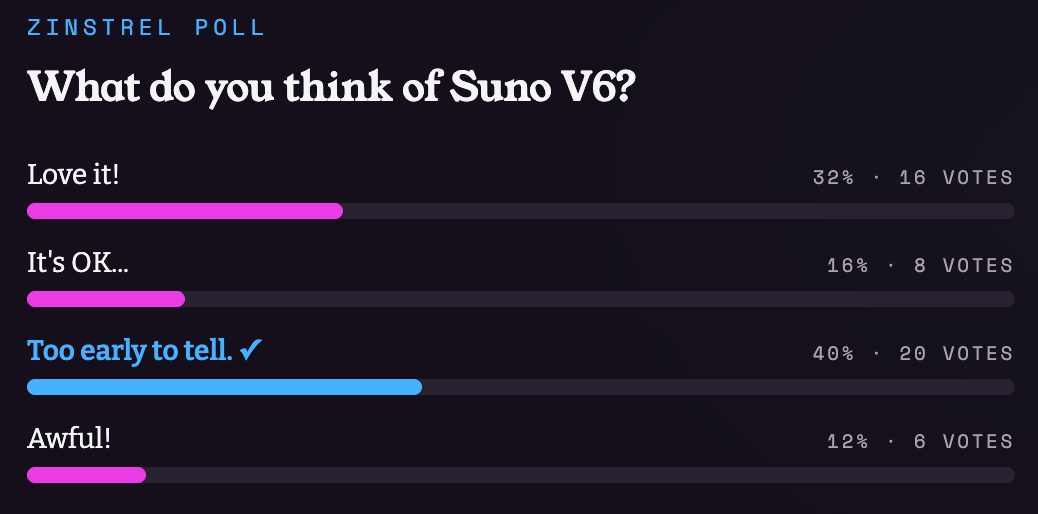
The release of Suno V6 was met with lots of energy and strong opinions, and nearly a week into its release, people say they love it or are still in wait-and-see mode with the new models.
➡️ Take this week’s poll, which asks: Will you use AI music remix tools?
MORE SIGNALS

SIQA Sets Inaugural AI Music Awards for November in Downtown LA
The Sonic Intelligence Academy (SIQA) has announced the AIMAs — the AI Music Awards — a two-day event Nov. 12–13 in Downtown LA. It starts with an industry summit, and culminates with what organizers call the first AI music awards ceremony decided by verified AI artists rather than algorithmic charts. The awards span 25 categories from Song and Artist of the Year to ten genre-specific fields, with every nominee cleared through SIQA’s registry verification process.
Tickets are on sale now at $250, with the venue capped at 600 seats and fewer than 100 held for public sale — a scarcity model signaling SIQA is positioning this as an industry-insider night first. Zinstrel will be on the ground for both days; Editor Marcus Lawrence sits on SIQA’s Creative Advisory Council and will cover the summit and ceremony in person.
Zinstrel & ElevenMusic Launch Song Contest
Zinstrel’s own contest — “The Zinstrel Challenge, Presented by ElevenMusic” — is now open for entries through Sept. 28, on the heels of the release of ElevenMusic v2.5. Songs must use ElevenMusic at some stage of production and provide a song link.
The wrinkle is that this isn’t just a generation contest: entrants have to show their work, making process transparency part of the competition itself.
On Oct. 2, eleven finalists will advance to a ranked-choice public vote through Oct. 14, with first, second, and third places winning $1,000, $500, and $250, respectively. The challenge is designed to introduce the creator community to ElevenMusic’s new tools, and to really dig into how v2.5’s new features can fit into the workflow of AI-assisted songwriting. Stay tuned to this space for coverage of the Challenge as the month unfolds, and learn more about the contest — and enter — at zinstrel.com/challenge.
Soundverse AI Scored the Entire Miss Universe India Show
Soundverse AI’s agentic producer, Agent One, generated all 11 tracks used across the Miss Universe India pageant — from the opening walk through the crowning of Kaziah Liz Mejo. According to Founder Sourabh Pateriya, all the songs were built from a single creative brief. Soundverse says the agent handled composition, kept a consistent sonic identity across the full runway, and iterated without the usual back-and-forth production cycle. It’s a big win for AI music in the public sphere, and a telling data point on where agentic AI music tools might find commercial footing first: not displacing composers on prestige film or ad scores, but absorbing high-volume, brief-driven live-event work. The full album of songs is now streaming on Spotify.
Google Flow Music Partners With Nigeria’s AI Film Festival for Lagos Demo
Google Flow Music will run a live demo at the Naija Artificial Intelligence Film Festival’s “Tools, Talent & Technology” workshop on Sept. 19 in Lagos, Nigeria — as part of a new partnership. NAIFF, now in its second year, will walk attendees through Google Flow Music across brainstorming, production, and storytelling. The tie-up is a case study in how AI music platforms are courting non-Western creative markets directly rather than waiting for organic adoption. NAIFF has built itself into a hub for African filmmakers and technologists since its 2025 debut, and Google’s presence there puts Flow in front of an audience defining “African AI storytelling” on its own terms.
AFM Pushes Back on UMG, Warner Motions to Dismiss
The American Federation of Musicians sued Universal and Warner this summer, claiming the labels broke their union contract by licensing members’ recordings to Suno and Udio for AI training without paying or notifying the artists involved — and after the labels asked the court to throw the case out, the union just filed its response, and it’s not backing down. The AFM argues that a “new use” clause in its contract plausibly requires payment here, which is all it needs to show to keep the case alive, and it also points to the labels’ own sampling rules as proof a payment framework already exists for cases like this.
The AFM also points to the fact that UMG and Warner sued Suno and Udio themselves back in 2024, warning AI-generated music could dilute royalty pools for artists — so the union’s point is simple: the labels clearly knew the stakes then, and it’s hard to take them seriously now that they’re arguing no payment is owed for the same use.
“Blow Us Away” Challenge Opens Across 10 AI Music Communities
SSC’s latest song challenge, “Blow Us Away” — built around wind instruments, sax to tuba, leading the composition — is live on song-sharing platform Vibya and is co-hosted by 10 different AI song communities including Soundgarden, AxiVision, Coletivo SomBR, and Storytellerz, spanning four languages. Submissions close Sept. 14. More than 150 creators are already registered, with sixteen winners set to split prizes from ElevenMusic, Google Flow Music, Neural Frames, Storia, and Zinstrel. The scale is notable for grassroots AI music events: multi-community co-hosting, blind listening matchups so every entry gets heard, and cross-platform sponsor gift codes at registration — evidence these creator-run challenges are professionalizing well past single-Discord contests.

SIQA Ships a Shazam App for AI Music
The Sonic Intelligence Academy (SIQA) released a free iPhone app, SIQA Verified, letting listeners point their phone at a playing song for a classification card — Fully AI-Generated, AI-Assisted, or Human + AI Hybrid — plus the specific signals detected, no account required. The catch: the song must already be in SIQA’s registry, making adoption a chicken-and-egg problem that scales with registry coverage, not downloads. It’s a notable step past labeling-as-policy: a Shazam-style verification layer for listeners, not platforms — though traction hinges on registry coverage outpacing fickle curiosity.
🎧 Song of the Day: “Strut” by Clarapetra [E]
Clarapetra’s new release Pretty Machine is a musically fascinating, multi-layered project that blends funk with chill electro-pop, bringing sonic interest that’s not typical in this space. Drum breakdowns, nicely timed horns, and electronic chime sounds all create a diverse sound that keeps our attention song after song. “Strut” is a head-nodder that vacillates between gentle vocals delivering bombastic lyrics and bigger musical moments carrying surprisingly understated lines.
💬 Last Word
“You can hate the tool. You can argue with the process. But at the end of the day, people decide what they actually want to listen to.”
— Pulseblend Studios Founder Vladimir Tokarev, via LinkedIn

MORE ZINSTREL:
Zinstrel.com | @zinstrelculture on IG | AI Underground on Discord
Zinstrel #113: Gold Rushes Always End — Even in AI Music
Zinstrel #112: Inside Listening Parties: AI Music’s Core Ritual
Created by Marcus Lawrence
Copyright 2025-2026 Zinstrel, LLC - All rights reserved
Special thanks to our paid subscribers: Blue Hermit, C.Y. Lee, Charles S, Chez, Daniel Drolet, Daniel Lares, Daryl Dekking, Dexter Garcia, Drew Thurlow, Jacci Cenci-McGrody, Lenny Skolnik, Lynn Clapp, Marc Wolinsky, Matthew Marturano, Matti Kuha, Mete Dibi, Rosanna, Sheila Spence, Steve Clapp, Steve Grossman, and Tim Burley.
Shulman's "there's not just going to be one product" is the closest Suno's come to admitting the revenue-sharing model for V6 isn't complete yet, even with Warner and BMG catalogue already licensed into it.
I'd rather watch the AFM's newly filed pushback against Universal and Warner's motion to dismiss over unpaid Suno and Udio training use - that's the fight that tests whether any of these royalty structures hold up.
Suno's got a live model with a label deal behind it; ElevenLabs has a signed UMG partnership and, as it appears, nothing built yet - which one actually pays artists first?
Check my article: https://substack.com/@outlawedversepoetry/note/p-215866751?utm_source=notes-share-action&r=2lq6ud