


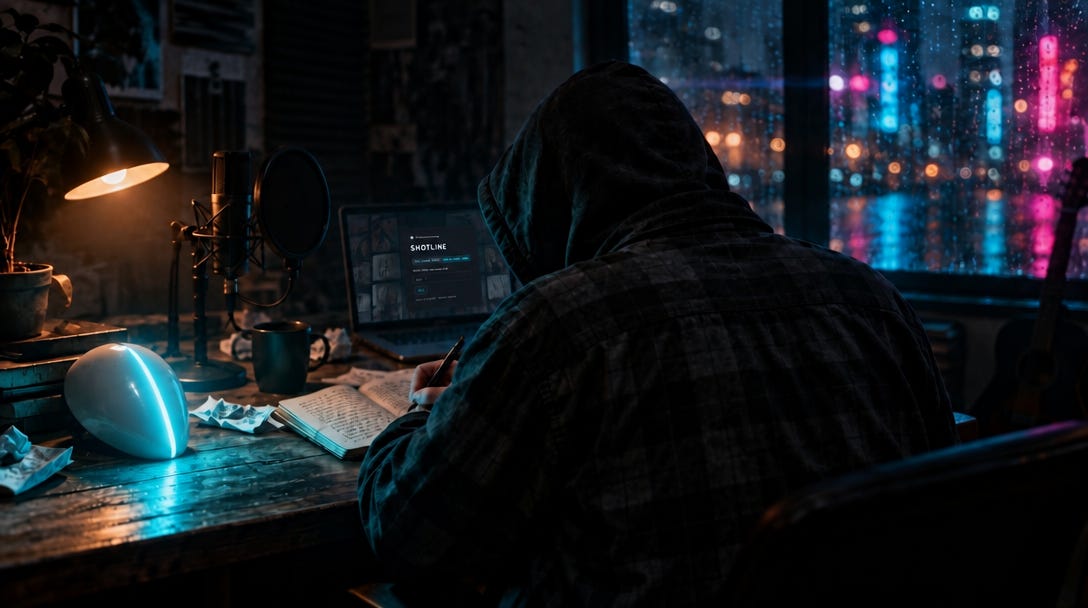
An AI rapper known as Aidan Yagu designed his trademark mask over a couple of weeks in November 2024. At the time, a consistent, original face was still hard for image models to produce, and he wanted one that “no one else can copy without effort.”
Throughout history, masks — whether for ritual, theater or festival — have turned their wearers into someone else. His had a different job.
“The idea of [the mask] was built to turn me into no one,” he says.
His artist name follows the same logic. Aidan Yagu is an anagram of “A Guy and AI,” which is how he describes his work.
“This music we do has two authors,” he says. “I may write myself, but I can’t really ‘do’ any of it.”
So putting his own face on the project never made sense to him.
“A photo of me would have been actually the most dishonest option if you think about it.”
Stage names are nothing new. What AI changes is what the name is being asked to represent. The writer, singer, face and performer no longer have to belong to the same person — or to a person at all.
Every artist still has to choose what to call themselves publicly, but for AI artists that choice can become an argument about authorship itself. Whose face belongs on a voice they didn’t sing? What does a name mean to a project created by both a human and an AI model? How much of the human creator belongs inside a synthetic character? Does revealing the person behind the project make the work more honest — or less?
We spoke with artists across AI music communities about why they chose their artist names. Their answers broadly fell into three camps, and while many of them reach for a mask, the question of whether to use a pseudonym matters less than the question behind it:
Who, exactly, is the artist’s name naming?
The Mask
For Yagu, anonymity protects the work.
“You put a face, an age, an accent and a country on a writer and you only create a lens that never comes off again,” he says.
In hip-hop, where realness is currency, that biographical context would be especially loud, since the writer behind Yagu is a European using an American AI voice to talk politics and socioeconomic issues.
So for Yagu, the mask isn’t about pretending someone else made the music. It’s about stripping away information he thinks would distort how the writing is heard.
“My writing ends up carrying the whole load, and that is exactly what it should do,” he says.
Being anonymous solves more ordinary problems, too. Yagu says some angry people online have tried to figure out who he is in order to make things difficult for him. Creator Marcello Parks, also a pseudonym, learned that the hard way. After publishing under a real name and being prank-called repeatedly, “I use a fake name to keep some distance.”
For others, an invented name doesn’t make them inaccessible and unknown. It lets them be more completely themselves — on their terms. Artist The Patchnote Prophet spent years adapting to what other people expected.
“Basically, I’ve been wearing a mask the entire time,” he says.
The name carries several meanings: an identity always under revision, patching notes in music, and an anti-prophet who tells people to think for themselves.
“It lets me be more me than with my real name,” he summarizes.
NeuroGlitch uses his alias so he can be completely honest in songs that reflect a negative view of himself and the world, without that view defining him to people who haven’t met him.
“It might give people a bad first impression before they even got to know me,” he says.
The distinction is small but important. One artist uses a pseudonym because it feels more like him; another because the work represents only one part of him.
Nowhere to Hide
JP Asher uses the same metaphor and reaches the opposite conclusion.
“I don’t use a pseudonym because I am done hiding who I am,” she says. For her, as a trans woman, an alias would be “like putting the mask back on. Going back in the closet. I could never.”
Where Yagu believes showing his face would misrepresent who made the music, Asher believes withholding hers would misrepresent who the music belongs to.
AI tools gave her back something she had lost. “I lost my voice when I was younger, and being able to use these tools as part of my musical process ... it was like getting my voice back.” Hearing it was “like hearing myself, my real self, again.”
She first put her name on her music because she didn’t expect anything to come of it. As her following grew, that choice came to matter. She sees no line between the artist and the person. “The songs and artworks ARE me.”
Roy Thigpen — whose musical content ranges from “I Married a Xenomorph” to songs protesting ICE — arrived at the same public choice for a different reason.
“I wanted to take away any excuses or places to hide,” says the on-camera host of the Monday night AI Factory livestream at AI:Underground. “This is me, good, bad or indifferent.”
Kai Hannover — the artist behind the FreeMusiers AI music community — kept his real name (styled K∧I) because “a pseudonym wouldn’t achieve” the sense of identifying with the artist. The name doesn’t need to protect him, embody a character or separate one body of work from another. Continuity is the entire point.
After releasing music traditionally on SoundCloud under her own name for more than a decade, Amanda Magellan saw no reason to change that once she started making music with Suno. She never felt the pull to invent a fictional artist, because she doesn’t think of herself as a storyteller first. She wanted to make the music she heard in her head, in whatever genre it happened to be.
“It would be weird to create one fictional artist or band with such a wide scope,” she says. Her songs share a loose mythology full of threads and Easter eggs, but the thread running through all of them is her.
The same choice — putting your own name on the work — can mean very different things. For Asher, the real name is identity. For Thigpen, it’s accountability. For Hannover, it’s continuity. For Magellan, it’s creative freedom.
Somewhere in Between
Then there are names that neither hide nor reveal. They simply do creative work, like any other artist or band name.
Daryl Dekking isn’t hiding. He just doesn’t think his given name is the point. His project Kara Vale, whose name grew out of his gamertag Karmilja, exists because his early songs called for a female voice, and his own name “felt less important than the world of Kara being convincing enough.” Her name doesn’t exist to fool listeners about Dekking. It’s there to make the project coherent.
Two leaders in the AI music world, Foggy X of Viibr and Professor Jacket of Fresh Friday Festival, aren’t hiding their real identities, either. They present as their personas because those names increasingly carry more meaning in their communities.
Professor Jacket — aka Zinstrel contributor Bobby Clark — came up with his moniker when he couldn’t remember Inspector Gadget’s name in a conversation. The inside joke became a persona, then a brand, and now it means more in the community than his real name.
“It’s not that I’m trying to hide it,” he says. “I just feel like I’m starting to become the alias.”
Foggy X, whose songs are credited to Peter Wolf on Spotify, says his real name is “not a deep state secret.” What the persona offers, though, is focus — creatively and socially. He also writes for a second persona, Stara, a singer who performs his songs, because writing “for Stara” helps him think like a songwriter writing for someone else.
Magellan — who typically writes under her own name — understands that perspective, too. She delved into a persona of her own. Creating RVSTGARDEN, fronted by the anti-heroine Viatrix Vermilivn, meant committing to a specific musical lane: “Neo-Baroque Victoriandustrial Folktronica and Alt-Rock.” For her, the alias is the constraint, and the real name is where she’s free.
Kara Vale gives Dekking a world to write toward. Professor Jacket gives Clark a name the community already trusts. Stara gives Foggy X a voice to write for. Nothing in what they’re doing requires the creator behind them to disappear.
What the Fiction Is For
Personas have always been a songwriting device. Ziggy Stardust let David Bowie sing things he might not have sung as himself. Eminem has Slim Shady, while Garth Brooks had Chris Gaines. More than a decade before making music with AI, Blue Idoru’s creator was making Vocaloid songs, already separating the human writer from the voice performing the work.
What AI changes is how completely a persona can now be embodied. Image, voice and music generation can all reinforce the same fiction without requiring a human performer to physically become the character.
And the more complete the character becomes, the less obvious it is where the persona ends and the person behind it begins. A name can now describe the human creator, the fictional performer, the relationship between them or something in between.
Look closely and almost nobody here is simply hiding or simply exposed. There’s nuance. Yagu, the Patchnote Prophet and Asher are each trying, in their own way, to remove a mask. They just disagree about which face is wearing it.
Blue Idoru’s creator first drew her in a manga app in 2011, and she has been rebuilt with nearly every generation of image tools since: Artbreeder, Stable Diffusion and a custom Flux model. Her voice is fully synthetic.
Her creator’s name isn’t hidden. It’s on everything DistroKid sends out to streaming platforms. But artistically, that name is being held for something specific: “I am reserving my real name for when I can produce music without AI.”
That boundary gets at something the other answers circle around. An artist name isn’t only an identity. It’s also a claim of authorship, a way of saying this kind of making belongs to this version of me.
There’s no formula to this, because authenticity isn’t a fixed point. It depends on what each creator believes the name is supposed to tell us.
Real names can be masks. Fake names can be disclosures. Personas can be characters, boundaries, writing tools or containers for pieces of a person that don’t fit anywhere else.
For Yagu, the man in the mask, the persona is an invitation to get closer, not farther away. The people who really listen, he says, “know me much closer than anyone else in my life, really.”
“And that is the whole point of it.”
💿 Album Review: Give In by Ruby Darkrose
Ruby Darkrose’s R&B album Give In functions as both an accessible, nine-scene erotic narrative about desire and a compelling emotional companion to her novel The Call of Arabic Desire. Zinstrel reviewer DLayman argues that the record's compact, direct approach successfully navigates the complex tangle of agency, dominance, and fantasy without losing its emotional core.
🎙️ SIQA Top AI Songs of the Week

The top half of the SIQA Top AI Songs chart remains completely frozen this week, with The Second Voice’s “Let Me Be” holding No. 1 and the entire Top 5 unchanged. The movement comes below that: Nyqki Nicole’s “Girl, I Am Anointed” jumps two spots to No. 6, while Delana Hope’s “I Speak Blessings” enters at No. 9, knocking Sheena Taylor’s “I Denounce You Satan” out of the Top 10.
🎧 Song of the Day: “Poison Garden” by RVSTGARDEN
Featured in today’s Culture story, Amanda Magellan is releasing music both as herself and as her “Neo-Baroque Victoriandustrial Folktronica and Alt-Rock” project, RVSTGARDEN. This chill, new-age, dramatic song carries peace and angst simultaneously.
💬 Last Word
“When anything can be created in minutes, time becomes the thing we value. The artist who keeps going. The craftsperson who does it properly. The person who makes something beautiful slowly.”
— James Roberts (Owner/Founder of Method), via LinkedIn

Zinstrel: AI Music News & Discovery is a 3x/week publication covering the tools, culture, and power shifts shaping AI music. Subscribe to stay in the loop — free or paid.
MORE ZINSTREL:
Zinstrel.com | @zinstrelculture on IG | AI Underground on Discord
Zinstrel #120: AI Labels Now Reach 60% of Streaming Music
Zinstrel #119: What the West Can Learn from China’s AI Remix Platforms
Created by Marcus Lawrence
Copyright 2025-2026 Zinstrel, LLC - All rights reserved
Special thanks to our paid subscribers: Blue Hermit, Bukar Gadzama, C.Y. Lee,
Charles S, Chez, Daniel Drolet, Daryl Dekking, Dave, Dexter Garcia, Drew Thurlow,
Ghost Ryder, Itai Leibowitz, Jacci Cenci-McGrody, Lenny Skolnik, Lynn Clapp,
Marc Wolinsky, Matthew Marturano, Matti Kuha, Mete Dibi, Rosanna, Sheila Spence,
Steve Clapp, Steve Grossman, Tim Burley, and Tracy Maddux.
Disclosures: Marcus Lawrence serves on SIQA's Creative Advisory Council.
The Zinstrel Challenge is presented by ElevenMusic, from ElevenLabs.
Marcus, Been following you for about 6 weeks. Just did a paid subscription. Been a musician since the 60’s. Had a hit record then. Built my first recording studio in 1974. Been a film and TV composer since the 80s. Jumped into AI music creation about 2 1/2 years ago. Your article today was excellent. It covered many AI music artists. What is there process? Prompts only, lyrics but not the music or music and lyrics and using the AI platform for arranging and vocals of music they write?
My community of music artists is mostly distraught by the advent of platforms like SUNO.
Brilliant piece Marcus! Really enjoyed this one. I know most of the artists mentioned in the piece, so it was really interesting to hear their perspectives on artist identities. Great work as always!