

MP3.com Has a Warning for Suno
Zinstrel #071 · Frame · AI Music News & Analysis

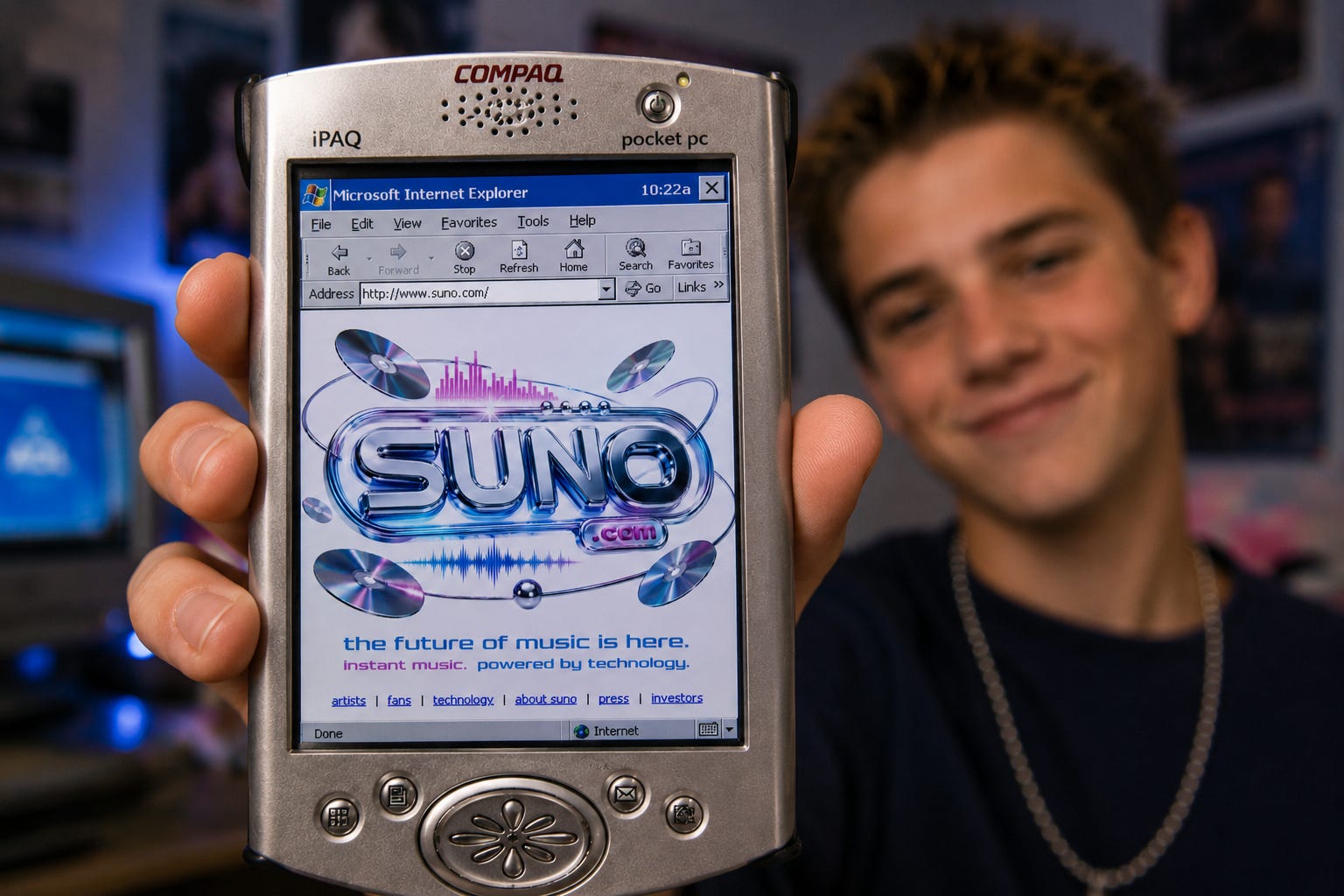
In July 1999, MP3.com went public on NASDAQ and became the largest tech IPO in history at the time. It was seen as the next big thing in music — a more legitimate future after the piracy chaos of Napster, giving fans a way to stream their own collections via the internet.
Despite all its success, MP3.com was brought down by infringement lawsuits from the major labels after using copyrighted music without permission. It won the users, the culture, and the market. But it lost the war.
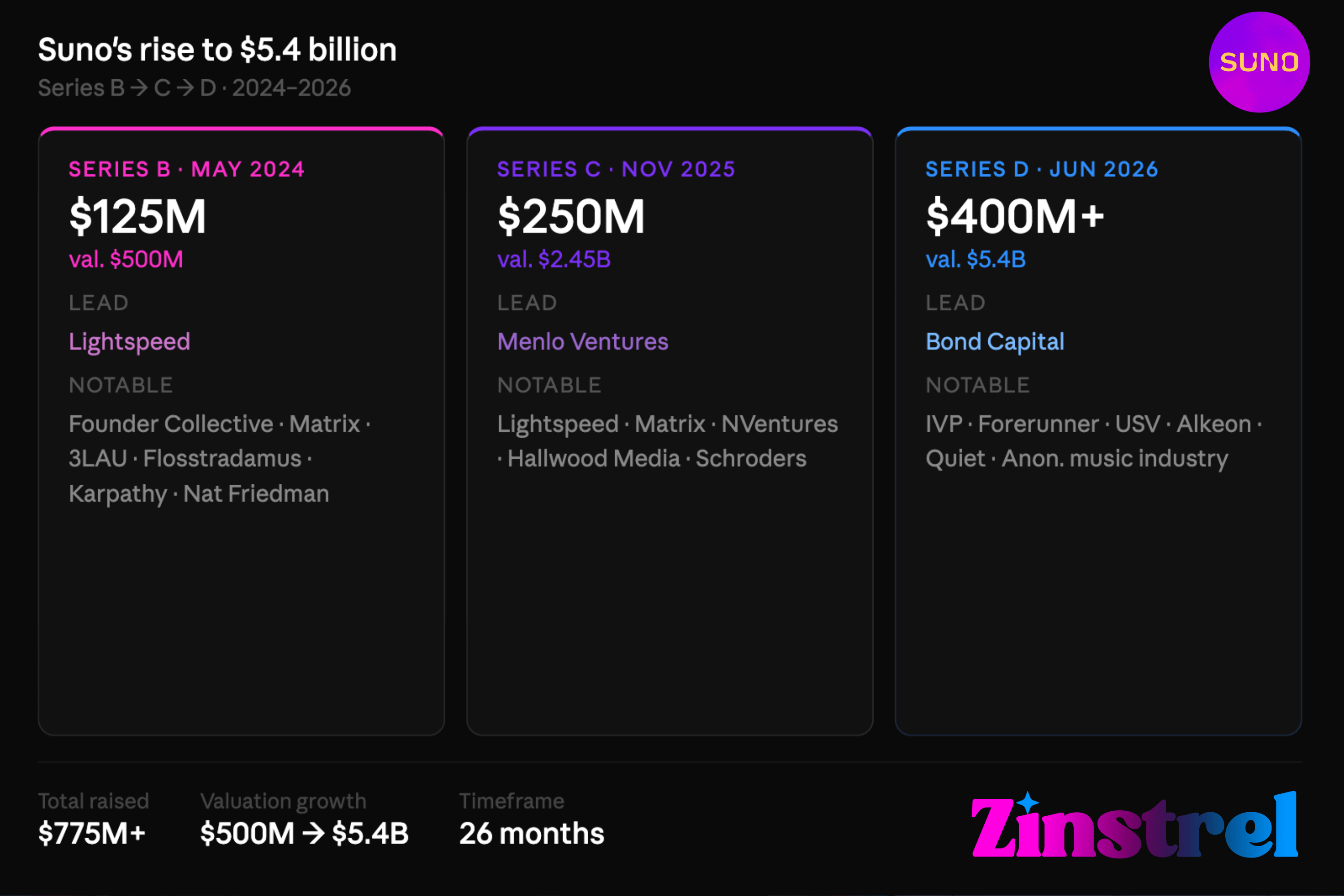
On June 3, leading AI music startup Suno announced a $400 million Series D at a $5.4 billion valuation — more than doubling the company’s worth in seven months. This happened despite active copyright infringement lawsuits filed by the same major labels.
If there’s anything to be learned from MP3.com, it’s that powerful investors, cultural momentum, and industry preeminence don’t equal invincibility.
Suno is celebrating right now. But will the company end up partying like it’s 1999?
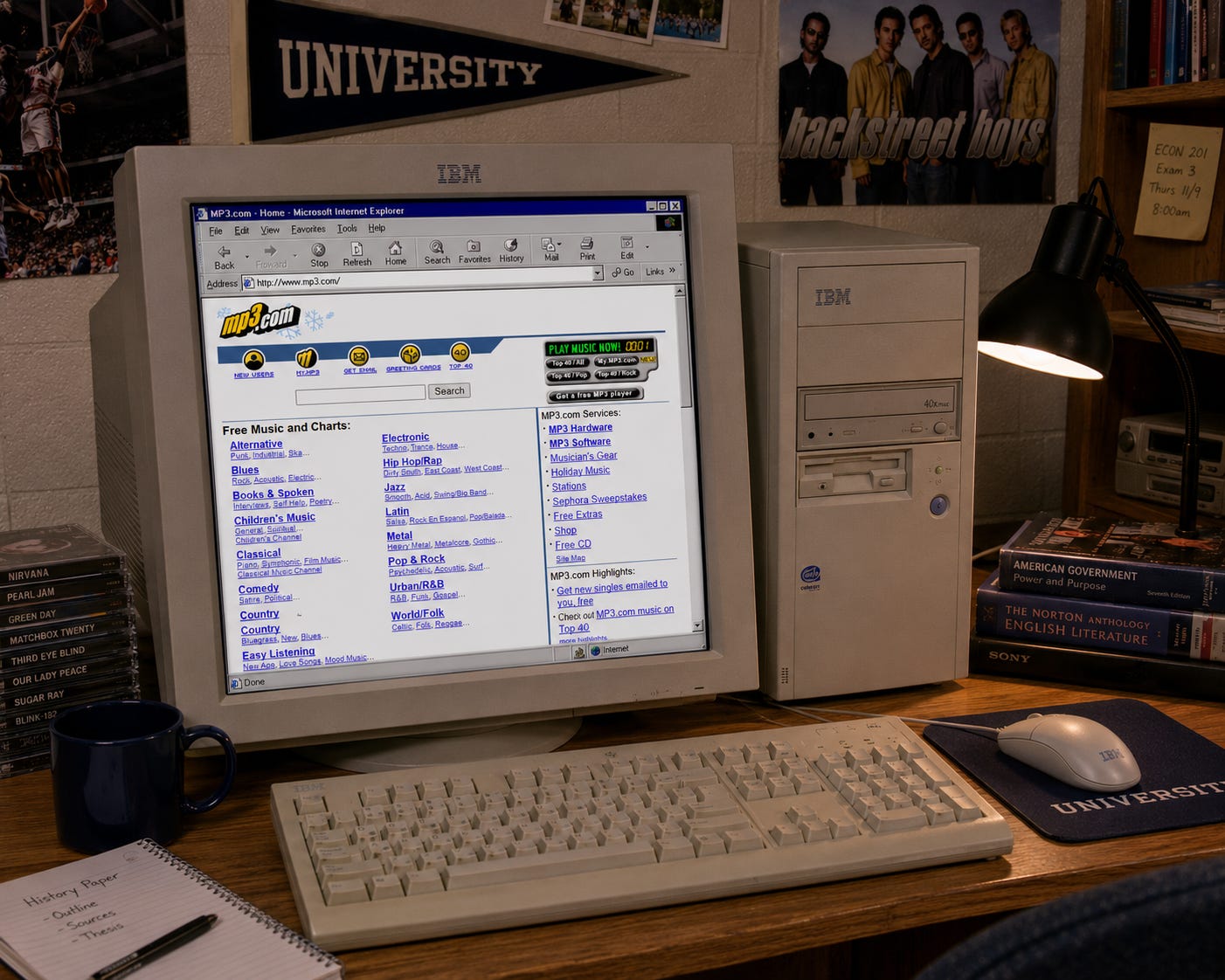
The Death of MP3.com
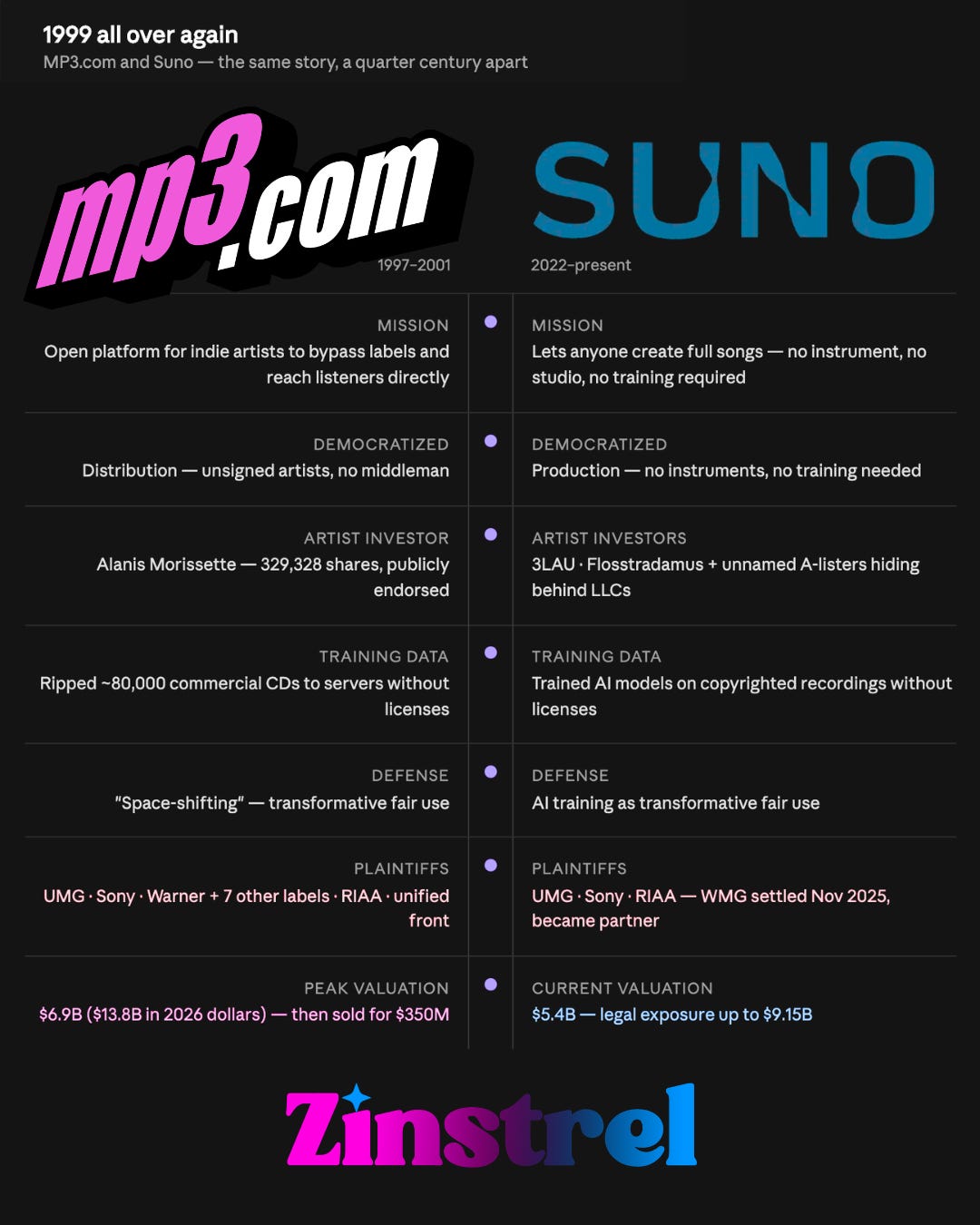
At its peak, MP3.com hit a market valuation of $6.9 billion — nearly $14 billion in 2026 dollars, more than double Suno’s latest valuation.
Its service was revolutionary and genuinely beloved. MP3.com began as an open platform for independent artists — a place where unsigned musicians could upload original music and reach listeners directly, bypassing the label system entirely. At its peak it was delivering over 4 million audio files a day to more than 800,000 unique users.
But when the company launched My.MP3.com — a feature that let users access their personal CD libraries from any internet-connected computer by inserting a disc once to verify ownership — Universal Music Group and a consortium of the most powerful record labels cried foul.
To build the service, MP3.com had ripped roughly 80,000 commercial CDs onto its own servers without licenses. UMG’s objection was straightforward: that copying was unlicensed reproduction, and a clever (though gamable) verification layer on top couldn’t change that.
MP3.com argued that ripping CDs to its servers was a transformative “space-shifting” use — that since users already owned the discs, the company was merely enabling personal access from a new location, not creating a new distribution channel. U.S. District Court Judge Jed Rakoff rejected this defense. The copying itself was commercial reproduction, regardless of what users did.
The financial unraveling was swift once the suit ended. The settlement with UMG alone cost $53.4 million, calculated at $25,000 per infringed work. Total settlements with all plaintiffs cost more than $200 million — more than half of what it raised in its IPO. What remained of MP3.com was sold for $350 million to Vivendi Universal, the parent company of the label that had destroyed it.
The technology had worked. The industry saw the brilliance. The users had loved it. The law didn’t care.
1999 All Over Again
The parallels between MP3.com and Suno aren’t a convenient rhetorical stretch. They’re bone-deep.
Both companies built ambitious, genuinely groundbreaking music platforms that disrupted industry norms — but in different layers.
MP3.com democratized distribution, making it possible for unsigned musicians to bypass labels and put finished songs directly in front of listeners. Suno has democratized production, letting people who may not play, sing, produce, or record create the song itself.
Both companies courted artist investors to help legitimize and normalize a controversial platform. MP3.com had Alanis Morissette. Suno claims to have top artists, producers, and songwriters among its investors, plus previous backers like 3LAU and Flosstradamus.
Back in 2000, Wired’s coverage of MP3.com’s lawsuit era offers a surprisingly familiar debate. The conversation at the time wasn’t really about whether people wanted digital music — it was about who would control it, who would get paid, and whether a new technology was violating copyright to create a better user experience.
Supporters called MP3.com’s service “revolutionary,” arguing it made music more accessible and could create new revenue streams for artists.
In his June 3 blog, Shulman said something similar: “We believe there’s a huge opportunity to create new experiences for fans while helping artists reach audiences, build community, and unlock new creative and economic possibilities.”
Now, as in 1999, the core tension remains remarkably the same: innovation moving faster than licensing, and an industry trying to decide whether a disruptive new technology represents the future or an infringement on the past.
Both MP3.com and Suno scaled by ingesting copyrighted material without permission. Both defended the practice as transformative fair use. Both were sued by major labels over the same underlying question, a quarter century apart: whether a new music technology can build commercial value from copyrighted recordings it never licensed.
Both were able to raise capital regardless — and from quite similar investors.
What the Money Sees
To understand why $400 million just poured into a company navigating formidable legal exposure, you have to look at who showed up for MP3.com back in the day.
MP3.com's institutional capital came from Sequoia Capital — backers of Apple, Yahoo!, and Google — and Idealab, the dot-com incubator that launched Overture, NetZero, and CitySearch. Suno’s equivalent is Bond Capital, IVP, and Forerunner. The roles are the same. The sophistication is different. And what each firm’s presence signals about Suno’s future is worth reading carefully.
Bond Capital, which led the round, built its reputation riding proven growth curves into household-name territory. Their portfolio includes Spotify, Uber, Airbnb, Canva, and Slack. Bond’s team has deep institutional knowledge of music platform scaling. When they lead a round into Suno, they aren’t making a technical bet on generative audio. They’re saying: we have seen this growth shape before, and we know what it becomes. They are Sequoia — but with twenty-five years of hindsight about what a music platform actually becomes at scale.
IVP — Institutional Venture Partners, one of Silicon Valley’s oldest later-stage firms — backed Netflix, Twitter, Snap, Discord, and Dropbox. Their pattern is consistent: they enter when a company has found explosive product-market fit and needs funding to build toward a public offering. IVP does not do experiments. Their presence suggests Suno is being financed like a company with public-market ambitions — and investors clearly believe the legal issues can be resolved before it gets there.
Forerunner Ventures is the most surprising name on the list and possibly the most revealing — because they don’t invest in technology. Their portfolio includes Dollar Shave Club, Warby Parker, Glossier, and Hims & Hers. They invest in consumer behavior shifts — the moment when a generation of people quietly starts doing something differently. And if they're right, Suno isn't the next Spotify, merely sharing music. It's the future of music itself.
The Series D investor class is betting that Suno has already become cultural infrastructure — and that the legal friction, however severe, is a problem that money, time, and patience can solve.
MP3.com’s investors believed something structurally similar. At $6.9 billion, so did the market.
What’s Different
To be fair to the thesis — and fairness matters here — Suno is operating with several variables MP3.com never had.
The most significant is the Warner Music Group settlement of November 2025, which resolved WMG’s portion of the original lawsuit and included Suno acquiring the Songkick concert discovery platform. That deal demonstrated something MP3.com never achieved: a major label willing to convert from adversary to partner. MP3.com faced unanimous industry opposition. Suno has fractured it, at least partially.
The cultural moment is different too. In 1999, digital music was a novelty. In 2026, AI-generated music is already on Billboard charts, already signed to labels, already embedded in the workflows of professional producers. Hallwood Media — whose team includes former UMG CFO Chuck Ciongoli and former UMG EVP Mike Biggane — is actively signing Suno creators to record deals while their former employer sues the platform those creators work on. The industry is most certainly not unified.
But not every 2026 variable cuts in Suno’s favor.
In 2000, when UMG sued MP3.com, there was no licensed digital music marketplace to point to. iTunes didn’t exist. Streaming didn’t exist. The labels were litigating into a void they had refused to fill themselves, which made their position morally complicated even when it was legally sound.
In 2026, that void is gone. The licensed AI music ecosystem is present, substantial and growing: generative platforms operating on clean datasets — Soundverse, Eleven Music, Google Flow Music among the largest — sit alongside active listening platforms like Udio, KLAY, and Spotify, all operating with licensing agreements. UMG and Sony can point to that landscape and make an argument MP3.com’s opponents never could: the ethical path exists, and Suno chose not to take it.
There’s also the question of timing. UMG sued MP3.com after its IPO — after 25 million registered users, after the stock had already made millionaires. The lawsuit arrived at the peak.
Suno is being sued on the way up, with $300 million in annual recurring revenue, 2 million paid subscribers, and 7 million songs generated daily — substantial, but not yet public. The legal pressure is landing earlier, during its institutional scaling phase, before shareholder accountability makes settlement politically complicated.
None of that scared off Bond Capital, IVP, and Forerunner. They wrote the checks anyway.
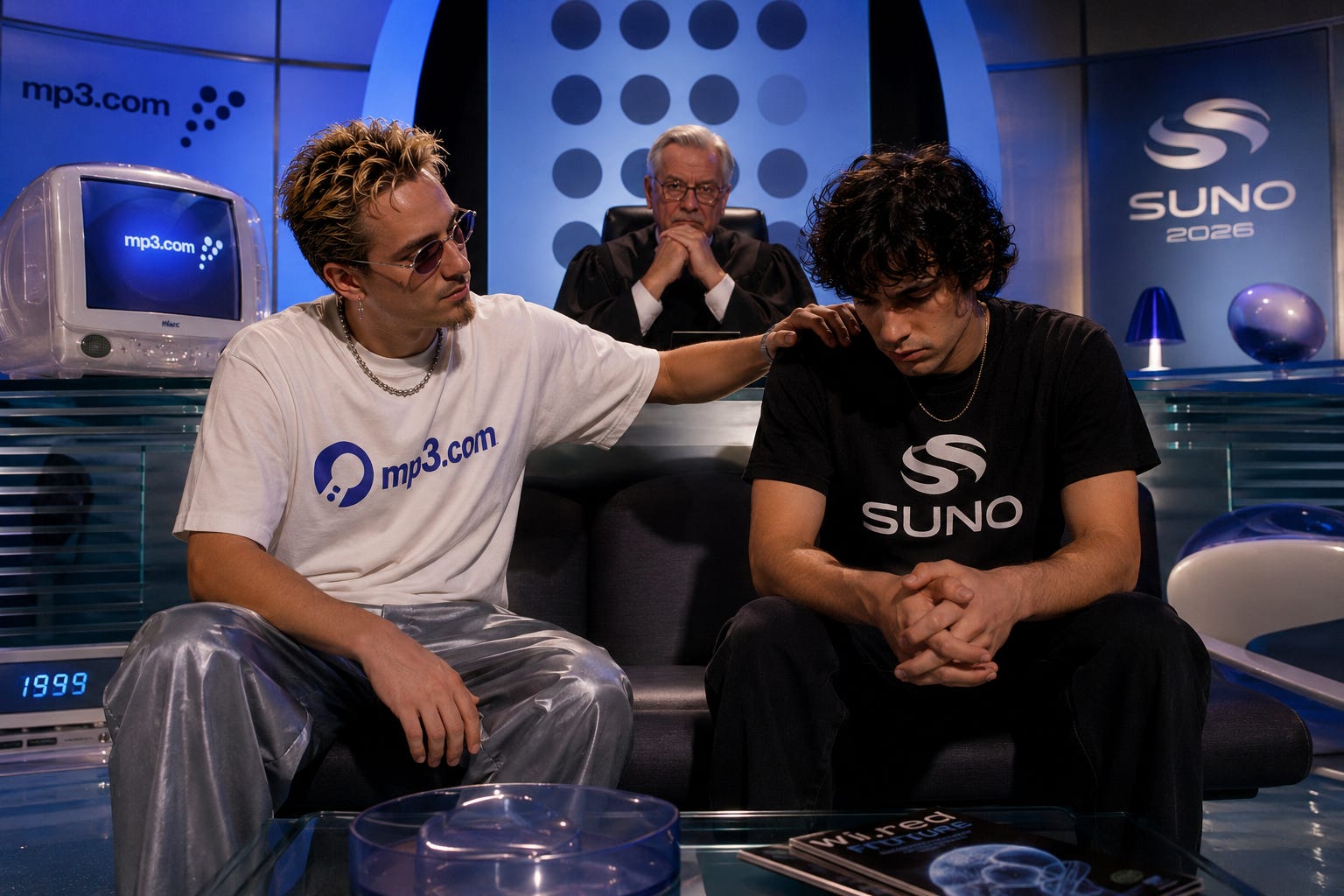
Money Doesn’t Stop the Train
Suno, UMG, and Sony are still in federal court in Massachusetts. The fair use defense Suno initially relied on is the same defense Judge Rakoff rejected in 2000. The core question — whether training a commercial AI model on copyrighted recordings without a license constitutes infringement — has not been settled. But by the end of this case, it will be.
On May 21, 2026, UMG and Sony deployed audio-fingerprinting technology to scan Suno’s datasets and filed a motion to add 61,026 specific recordings to the complaint. Under U.S. copyright law, willful infringement carries a maximum statutory penalty of $150,000 per track.
That single motion scales Suno’s existential exposure to $9.15 billion — roughly 170 times the total settlements that destroyed MP3.com.
A $400 million round of new capital doesn’t stop that legal train. It just delays it a little.
The investors who just wrote those checks know all of this. Bond has lived inside music-platform scale. IVP has navigated legal and regulatory overhang before. Matrix Partners’ Antonio Rodriguez, one of Suno’s earliest backers, told Rolling Stone in 2024 that music industry litigation was simply “the risk we had to underwrite when we invested.” Twenty-five years ago, Sequoia Capital made a similar calculation.
We know how that ended.
MP3.com had the users. It had the institutional confidence. It had the growth curve that looked, from inside a venture fund in 1999, like it could only go one direction. At its peak it was worth more than two and a half times what Suno is worth today.
When it was finished, it sold for $350 million — a 95% collapse in value — and its once-promising market position and cultural significance were lost to history.
Suno is replaying that tape at ten times the scale. The parallels are real. The only question is whether the ending has been rewritten, or if we’re headed for a post-Suno future.
The warning MP3.com has for Suno? The law doesn’t care how many users or investors love you.
🆕 New AI Music Releases
1VY - Late Checkout (R&B / Soul)
AI Garfunkel - Invictus Metamorphosis (Rock / Alternative)
Damita Jo - Check The Receipts (Gospel)
DJ LLG - Sangria’s in the sun (Electronic / Dance)
Double 0 Negative - I’m Who I Am (Rock / Alternative)
Fr@nkieVXXX - Dirty Detention (Pop)
Garbage Garden - Self-luminescent (Electronic / Dance)
Jeyms Caelwyn - I’m Still Inside (Pop)
K Λ I - Who I Am (Pop)
Kayla Truth - In My Midnight Hour (Christian / Gospel)
Layered Hearts - The Life Of A Gay Man Is Lonely (Pop)
Leea - Arraiá da Leea (Pop)
Marnie Blake - Don’t Make Me Be Cool (Pop)
Nicola Nicoletti - Like Anyone (Pop)
Roy Thigpen - Priceless relic, broken heart (Classical / Orchestral)
Solène - Sotto Corrente (Electronic / Dance)
Sycophant - Unknown Lows (Rock / Alternative)
🎧 Song of the Day: “Borrowed Songs (The Death of MP3.com)”
Yours truly, Zinstrel Editor Marcus Lawrence, makes AI music under the pseudonym TheWildSeven, and wrote a late-'90s-era emotional alternative rock song that tells the story of MP3.com and sings directly to Suno.
💬 Last Word
“Charts show you what already worked but scenes show you what is about to matter next. Are you studying finished success stories or paying attention to the culture forming before it gets named?”
— Charles Johnson, Founder and Head of A&R at Kre8tive Distribution, via LinkedIn

MORE ZINSTREL:
Zinstrel.com | @zinstrel_ai on Instagram | AI Underground on Discord | r/Zinstrel
Copyright 2025-2026 Zinstrel, LLC - All rights reserved
Written by Marcus Lawrence, courtesy of composition platform Versey.ai
Special thanks to our paid subscribers: C.Y. Lee, Daryl Dekking, Lynn Clapp, Steve Clapp, Mete Dibi, Daniel Lares, Dexter Garcia, Matthew Marturano, Sammy Stoltz, Tim Burley, Drew Thurlow, Sheila Spence, Lenny Skolnik, Màuhan Zonoozy, and Matti Kuha.
Great work, Marcus!
Well this is a sensational piece of journalism and a brilliant read.