



In July 2024, Philip Olajide-Philips needed a song in Yoruba. He called around to studios in Lagos, and the quotes came back at $300 to $400.
“That was just too much money,” he remembers thinking. “I didn’t have it.”
Olajide-Philips isn’t a stranger to music. He plays piano, drums, and guitar, sings, leads a choir, and has released two albums of his own. He’s also a software developer who studied AI at IBM back in 2019.
So instead of finding a way to pay the studio bill, he went looking for a way around it.
That was when he discovered, for the first time, AI tools that claimed to generate entire songs. Although the promise sounded almost perfectly suited to his problem, the results were disappointing.
“The most striking thing was that all these tools were built for the Western world, and Africa was actually omitted,” he told Zinstrel. “I put in African lyrics like Yoruba, and the white man was singing it very funny.”
The models could process the Yoruba lyrics. They couldn’t sing them like Yoruba.
To Olajide-Philips, it sounded less like a native speaker than the way a tourist reads a phrasebook aloud. That was difficult to dismiss as some obscure edge case. Yoruba is spoken by tens of millions of people worldwide.
And the problem didn’t stop with pronunciation. He found the instrumentation and musical vocabulary behind authentically African sounds lacking, too.
“How could they have done this?” he remembers asking. “Africa is large. Is it that they just want to leave us behind?”
That question is where KorinAI began.
It’s also a question now surfacing independently across raga, maqam, Amapiano, Latin music, and other traditions that don’t fit neatly inside the musical assumptions of the first generation of generative AI.
From frustration to a founder
Olajide-Philips figured he already had two pieces of what he needed: a background in software and enough musical experience to understand what the models were getting wrong. So he spent the next six months studying AI music generation.
Then, during a trip to Australia in December 2024, he entered a generative AI hackathon — a fast-paced competition where participants build applications around a provided technology stack. (We profiled one such hackathon recently.) His team placed third in an event he said drew roughly 4,000 participants.
The prototype they built together became the beginning of his African music generator.
Olajide-Philips kept working on it over the next eight months until he had a minimum viable product. He called it Korin, from the Yoruba word for “sing.”
But KorinAI isn’t attempting to build a frontier music model from scratch. That would require enormous amounts of computing power, data, and capital the startup doesn’t have.
Instead, the company builds on open-source models and adapts them for African languages and sounds using music obtained from partners, producers, artists, and copyright-cleared sources.
“We tune the model to what we are doing in Africa,” Olajide-Philips said.
Yoruba, Igbo, and Nigerian Pidgin are live today, with additional African languages planned as resources allow.
KorinAI’s goal is to make the underlying system better understand the language, vocals, rhythms, and musical characteristics it is being asked to reproduce, rather than simply putting African genre names in a menu of options within a general-purpose model.
The night the room found out
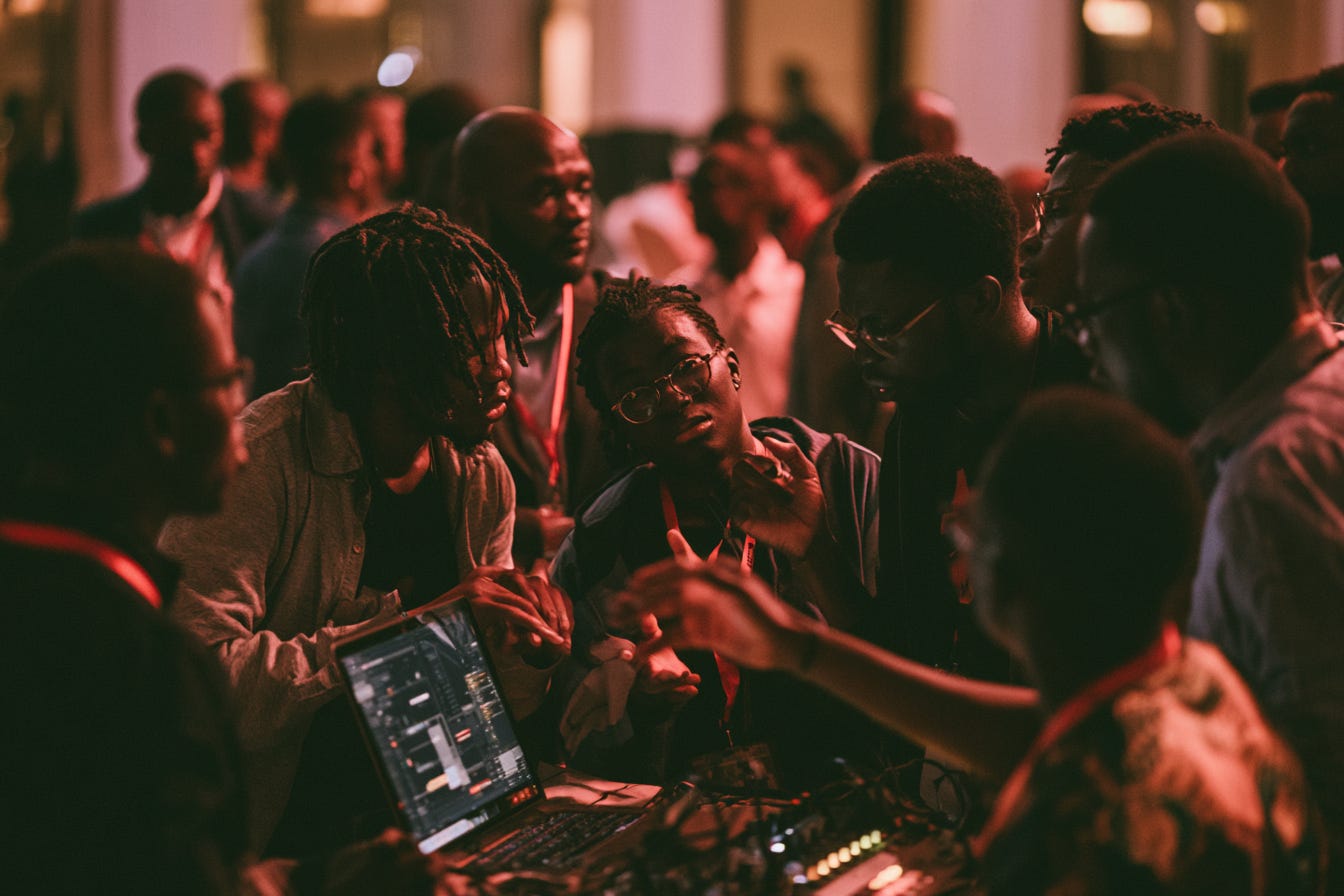
One of Olajide-Philips’ favorite demonstrations of KorinAI didn’t happen in a lab, but at a bustling conference in Abuja.
KorinAI built the music for the event, creating an entire 30-song playlist that ran throughout the day. By Olajide-Philips’ account, nobody in the room appeared to notice anything unusual about it until the emcee stopped the event.
“’I’d like to bust your bubble,’” Olajide-Philips recalled the emcee telling the audience. “’All the songs we’ve been listening to were all generated by AI.’”
The reaction changed immediately. They were shocked.
“They all came to me asking, ‘How did you do that?’”
For KorinAI, that experiment hinted at something beyond individual creators making songs.
Nigeria already requires paid licenses for the public performance of copyrighted music, and the Nigerian Copyright Commission has recently put more pressure on DJs and event managers to comply. In June 2025, the commission warned that DJs playing music publicly without authorization could face prosecution under the country’s 2022 Copyright Act.
Olajide-Philips sees an opening there.
Rather than businesses relying entirely on conventionally licensed catalogs, KorinAI says it can provide copyright-compliant songs. Those songs are available one at a time now, but the platform could eventually offer businesses an entire AI-generated catalog whose usage rights are cleared through the platform itself. In his vision, businesses get another source of music while creators participating in the KorinAI ecosystem can be compensated when that music is licensed.
“So now it has given us a sort of revenue for us,” he said. And for the artists.
It’s still an emerging business model. But it turns the thing that originally made KorinAI attractive — cheaper access to music creation — into a possible market on the other end as well.
What’s still missing, and what it would take
KorinAI now has more than 2,000 users, according to Olajide-Philips, and growth so far has been largely organic.
The platform operates on a freemium model, with new users able to generate two free songs. Olajide-Philips has much larger ambitions for its reach, but says the biggest challenge isn’t getting people to sign up or be excited about the tool. Unsurprisingly, it’s money.
“Funding has been our challenge, which is slowing down our growth,” he told Zinstrel.
That’s ratcheting up the pressure, because the roadmap is getting more ambitious.
The team is currently developing Korin 2.0, which Olajide-Philips says will allow users to upload their own voice and use it in a generated song. Direct distribution relationships with platforms like Spotify and Apple Music remain another short-term goal, so users can upload directly to those platforms from KorinAI.
The nine-person operation includes other technologists with musical backgrounds, including co-founder Solomon Ogunbowale, who left Goldman Sachs to work as KorinAI’s backend and AI engineer. Together, they’re taking the pressure in stride, and continue to see positive momentum.
The platform’s biggest outside validation arrived when KorinAI was named a Global Winner in the Culture & Heritage category at the 2025 World Summit Awards, an international digital-innovation program operating in the context of the UN World Summit on the Information Society. As one of the winning projects, KorinAI presented to an international audience at the WSA Global Congress in Vienna in May.
The recognition was notable, because KorinAI’s win had nothing to do with being able to generate just another AI song.
It won for its contribution to culture and heritage.
For Olajide-Philips, that reflects the reason he built the platform in the first place.
“An average up-and-coming artist in Africa doesn’t have the money to book a recording studio or session musicians,” he said. “Some of them have real talent, but they need to at least get their demo out there.”
He remembers one musician who had been sitting on lyrics for years finally hearing them turned into a song.
“I just cannot believe that my song I wrote many years ago is now live,” the musician told him.
The studio bill that Olajide-Philips couldn’t afford had become someone else’s way around the same problem.
“As AI becomes mainstream, Africa must not be left behind,” he said. “I am building KorinAI to ensure African culture is represented, preserved, and amplified.”
It isn’t just Yoruba
The interesting thing is that Olajide-Philips arrived at that argument at roughly the same moment builders elsewhere began reaching versions of it themselves.
In India, Debjit Mitra’s RaagaPay is tackling a different failure in the same underlying system.
Indian classical music doesn’t map cleanly onto the 12-tone equal-tempered framework that dominates Western music technology. RaagaPay is building a rights-cleared training corpus around concepts such as shruti, raga, tala, ornamentation, and musical lineage, with dozens of metadata points attached to each performance.
Its pitch to AI developers is essentially that calling something “Indian classical” isn’t enough. The model has to understand the musical system underneath it.
Musica AI, led by Yoan Valiente, is approaching Latin music from a similar direction, treating cumbia, bachata, son cubano, and other traditions as distinct musical systems rather than collapsing them into a generic “Latin” category.
And in Africa, KorinAI is just the beginning of what’s emerging. In South Africa, Gift Lubele’s Auraa started with what it describes as the region’s first fully AI-generated Amapiano album before expanding into Afrobeats and Highlife, building a catalog of roughly 1,500 tracks and more than 700,000 Spotify streams while picking up a Huawei Grand Innovation Award. AfroNova, operating out of Lagos and Johannesburg, is pursuing similar territory.
And at Wits University, the AI & Africa Music project is taking a less commercial route, with five artist-engineer teams developing culturally rooted AI projects around preservation, archives, education, performance, and community-controlled data. One of them, the Bɛ̀bɛ̀i Engine, was co-created with Cameroon’s Baka community around polyphonic singing, water drumming, and yodeling traditions.
And this is only the beginning: in the Gulf, Riyadh-founded rhythmi and NabadAi are building maqam-aware, Arabic-dialect-fluent systems, while in Jamaica, OpenJM is rolling out culturally grounded music generation into a broader platform built around data sovereignty.
Across the world, the products are different, the business models are different, and the cultures are different. But they’re increasingly trying to solve versions of the same problem: making sure AI understands their musical traditions as systems in their own right, rather than approximations of somebody else’s.
What it all comes back to
None of these projects is really making the argument that every musical culture needs its own isolated AI. Instead, each makes a case against treating one musical system as universal.
Train a model to understand one tradition in fine detail and leave everything else to approximation, and the result isn’t neutral. One becomes the baseline. Everything else becomes a variation on it.
That’s what builders like KorinAI, RaagaPay, Musica AI, Auraa, and the Wits teams are trying to change. AI can already make something that sounds African, Indian, Latin, or Arabic. The harder task is teaching it to understand raga, Amapiano, Yoruba delivery, maqam, and other traditions as musical systems with rules of their own — rather than deviations from whatever the model learned to call normal.
For the builders behind these platforms, that is bigger than just expanding what AI music can do. It’s carrying their musical heritage into AI on its own terms.
💿 SIQA Top AI Songs of the Week

After its record-breaking run atop the Top AI Songs chart, “Let Me Be” by The Second Voice has relinquished its crown to none other than the AI song of the summer, “RUBBERZ” by Fenix Flexin.
🎧 Song of the Day: “Clear” by DropKick Princess
Fresh off the Aug. 21 Meta-Tartarus release, “Clear” carries DKP’s “sitcom energy meets chaotic indie pop” with a ‘90s-adjacent, story-driven alternative rock sound.
💬 Last Word
“People think AI will replace critical thinking… While I’m watching it expose who never practiced it.”
— AI writer Pietro Montaldo, via Substack

Zinstrel: AI Music News & Discovery is a 3x/week publication covering the tools, culture, and power shifts shaping AI music. Subscribe to stay in the loop — free or paid.
MORE ZINSTREL:
Zinstrel.com | @zinstrel_ai on IG | AI Underground on Discord
Written by Marcus Lawrence, courtesy of composition platform Versey.ai.
I use em dashes proudly.
Special thanks to our paid subscribers: Blue Hermit, C.Y. Lee, Charles S., Daniel Drolet, Daniel Lares, Daryl Dekking, Dexter Garcia, Drew Thurlow, Jacci Cenci-McGrody, Lenny Skolnik, Lynn Clapp, Marc Wolinsky, Matthew Marturano, Matti Kuha, Mete Dibi, Sheila Spence, Steve Clapp, Steve Grossman, and Tim Burley.
Hey I may end up using some of those AI tools. Sounds Awesome!