

Five Things AI Creators Wish You Knew
Zinstrel #079 · Culture · AI Music News & Analysis
The conversations and debates surrounding AI music are well-known. The legitimacy of the medium, the ethics of training data, the threat to working musicians, the question of whether a machine-assisted song can carry real feeling — these arguments play out daily on Reddit threads, in YouTube comment sections, and across music journalism like Zinstrel.
But inside the AI music communities themselves — where the real people using these tools share songs, tips, stories, and pieces of their lives — there are different conversations taking place. Conversations about why these artists make music this way, what it costs them, what it’s given them, and what they’re tired of explaining.
On Sunday, June 21, one of the leading AI music communities, AI:Underground, transformed its Discord server into a day-long festival for Make Music Day — more than a dozen community creators running back-to-back voice-channel booths, with activities spanning psytrance jam sessions, build-a-song workshops, collaborative remix relays, a digital fashion show, and more.
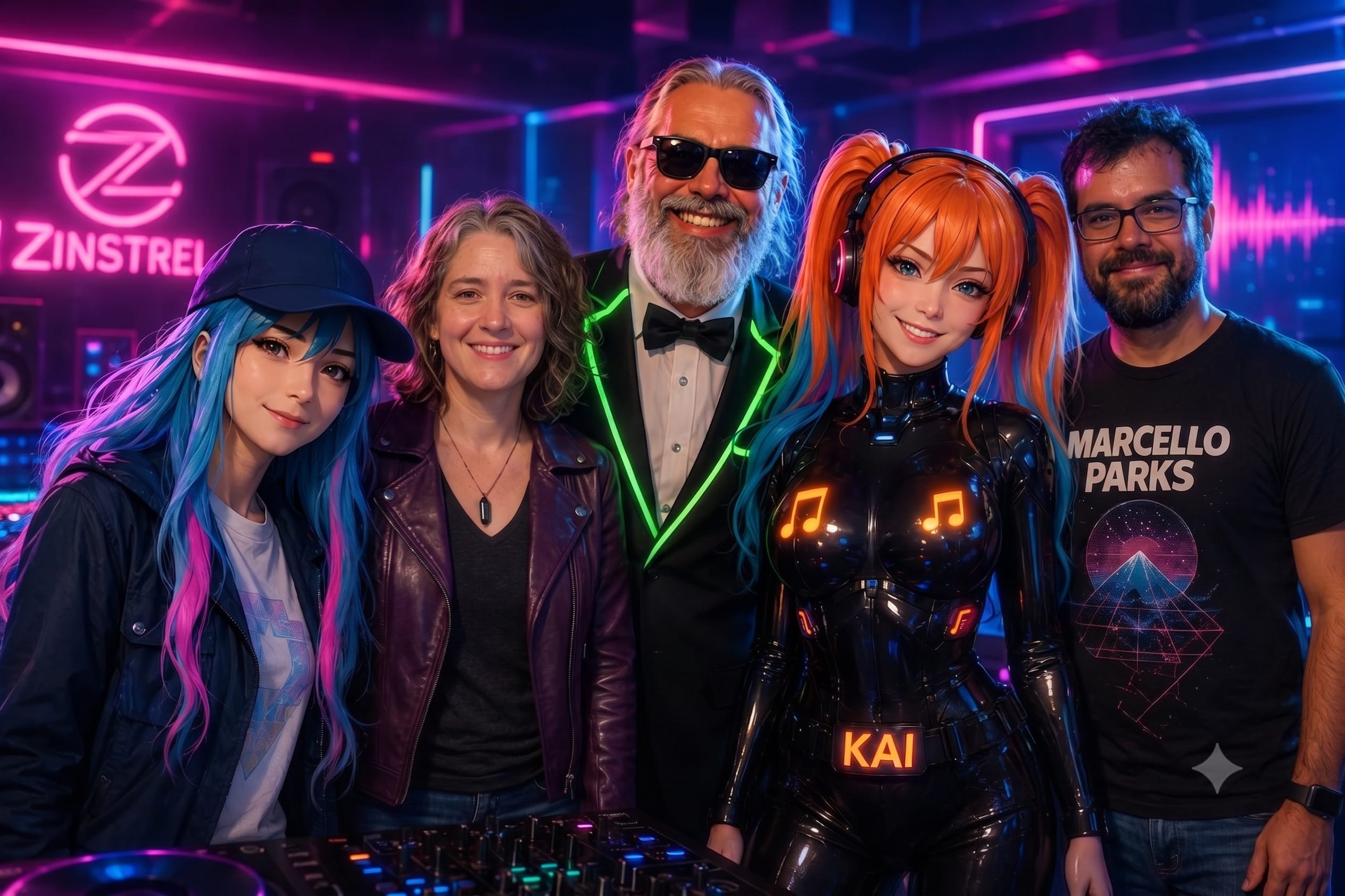
Zinstrel was there to conduct rapid-fire interviews with some of the community’s top creators. The five creators who went on record — JP Asher, Urban Humans, Roy Thigpen, K ᐱ I, and Marcello Parks — do not speak for every AI musician. But together, their stories show how much the outside conversation tends to miss.
The Creators
JP Asher is a British producer and SSC8 runner-up whose music moves through acid house, drum and bass, jungle, kwaito, and multilingual dance hybrids. A self-taught multi-instrumentalist, she’s known for intricate internal rhymes, sharp sampling instincts, and turning “failed” AI generations into hooks for entirely new tracks.
Urban Humans is the recording project of Andrea BMR, whose genre-fluid catalog spans pop, J-pop, K-pop, and rock. Her songs often draw from identity, empowerment, gender dysphoria, and self-discovery, but they rarely stay in confessional mode for long — the music is bright, restless, direct, and often built to move.
Roy Thigpen is a professional stagehand, lifelong music obsessive, and AI music community builder whose catalog ranges from protest songs and spirituals to satirical genre mash-ups like the wonderfully unclassifiable “So I Married a Xenomorph.” Raised by a piano maestra, he brings classical, rock, and Latin American roots into his work, while also coding tools like Songalyzer and hosting AI:U’s Monday night Twitch livestream.
K ᐱ I is a daily creator from Germany who, after being banned from Bandcamp for making AI music, built a new platform for AI music creators: bancamp.de. Starting with no formal music background, they’ve become a prolific synth-pop experimentalist, using their own voice and custom models trained on intentionally broken audio to create strange, distinct, otherworldly personas.
Marcello Parks is a former fiction author who spent 25 years wanting to make music before AI tools gave him a way in. Working under a pseudonym from an unpublished novel, he makes narrative-driven party music — upbeat dance production paired with dark storytelling, emotional escape, and long-delayed creative release.
1. AI music let in people who had no other door
None of these five creators came from a conventional musical path. Not one.
Asher had the ear and the vision but equipment too limited to realize it. Thigpen absorbed music through osmosis in a household full of it and never found a way out of it. K ᐱ I arrived with no background at all — just a feeling for what they liked. And then there are Parks and Andrea, whose stories carry a different kind of weight.
Parks was turned away from a music major in college — told he should have started before he arrived. He spent the next 25 years wanting to make trance and techno and house, and couldn’t. He’s also autistic, with fine motor skill issues that make playing instruments difficult. “I have the musical ideas, and I can now turn those ideas into reality,” he said, “because I lack the ability to otherwise turn them into reality.”
Andrea came to songwriting not through musical aspiration but through survival — she needed an outlet for what she was carrying, and she found one. The music wasn’t the goal. Expression was.
The criticism that AI music attracts people who didn’t want to put in the work misunderstands who is actually making it. Many of them spent years — in some cases decades — wanting to make music and finding the conventional system had no place for them. The fine motor issues, the ADHD, the financial barrier to equipment, the college professor who said no, the emotional need that arrived before any training could. These aren’t excuses. They’re the actual story.
2. The creative process is real, and they can prove it
The first thing most of these creators encounter when they share their work publicly is some version of the same dismissal: “You just pressed a button.” And all of them have developed their own answer to it.
Asher’s answer is to open her project files. A self-taught FL Studio user from the Fruity Loops days, she pulls single hooks from failed generations and builds whole tracks around them — assembling layers the way she once assembled blocks on a timeline in Dance eJay 2. “I open up my studio projects and show them this complete labyrinth,” she says. “And I say to them, ‘Yeah, you can do this, can you?’”
Thigpen’s answer is the most literal: he builds the tools. His unreleased Promptalyzer features a piano roll editor and isolated audio stems, letting him engineer specific constraints before the AI generates a single note. He also researches the historical roots of every genre he touches and writes intricate nested rhyme schemes — craft decisions the machine doesn’t make for him.
K ᐱ I’s answer is embedded in the sound itself — synth-pop built on custom models trained on intentionally broken audio, producing textures no default generation would reach. Parks’s is quieter: best of two generations, mark what needs to change, remix, refine, repeat.
Every one of these creators has developed a real methodology. The button-press narrative isn’t just inaccurate — it’s a specific kind of insult, the one that says the methodology doesn’t exist.
3. AI music made them more curious about music, not less
The assumption built into most AI music criticism is that these tools are shortcuts — ways around the hard work of musical understanding. The reality, at least in this conversation, runs in the opposite direction.
Thigpen grew up in a household with two pianos and classical music in the car, absorbed it all, and performed none of it — bad early experiences with teachers, some undiagnosed ADHD, and music became something he listened to rather than made. Since starting with AI, he’s found himself deep in community conversations about musical lore — including recently the actual origins of the Robert Johnson crossroads legend, learning it was really Tommy Johnson the story was about.
“I take it pretty goddamn serious,” he says. “I have all you guys [in AI:U] to thank for that.”
Asher’s arc is the most vivid. All those years of self-teaching on bad equipment, recording guitar through a headset mic — none of it was wasted. When AI music arrived, she didn’t feel relieved to leave the work behind. She brought it with her. The ear she’d built, the instinct for what a song needs: all of it found new application. “I thought,” she says, “why the hell not?”
Parks picked up a music theory book because a community member inspired him to. He now works in Phrygian modes without looking them up. K ᐱ I spent their first months experimenting across every genre until they found their home in synth-pop — then built a full technical stack to get there.
Rather than replace curiosity, the tools gave curiosity somewhere to go.
4. Most of them are creating as a form of personal therapy
“To me it’s mostly therapy,” K ᐱ I says of making AI music. “I know a song is done when I start crying like a little baby.”
That answer — or a close version of it — surfaces in nearly every conversation. Asher’s song “Russian Doll” began in an actual therapy session, where a counselor described how circus elephants are conditioned through early trauma to remain afraid long after they’re strong enough to resist. She took that image, held it alongside her own experience, and turned it into a song.
Andrea started writing because of her struggles with gender dysphoria, found that the process helped her, and kept going — making music first, coming out publicly a year later.
“Maybe it could help others too,” she says.
Parks complicates the picture in a way that ultimately deepens it. He doesn’t find catharsis in music the way the others describe — he wrote a song about his parents’ death and didn’t find it therapeutic. For him, the therapy is escape.
“When I listen to music I want to forget,” he says. “I don’t want to dwell on the bad parts of my life. I come to escape the bad parts of my life, not return to them.” He still makes downer tracks — describes two recent ones as mirrors of each other, two people sitting in the shattered pieces of their lives. “Still a banger,” he adds. The emotional content is real. The frame around it is just different.
None of these five are making music for streaming numbers or platform algorithms. The audience, when it comes, is welcome. But it isn’t the reason.
5. They’re building their own legitimacy — and not waiting for permission
AI music is being made under brutal cultural headwinds. Platforms ban it, critics dismiss it, working musicians resent it, and casual listeners often recoil the moment the label is attached. These creators are constructing their own arguments for their own legitimacy — by hand, in individual conversations, repeatedly, often with people who have already made up their minds.
Thigpen makes that argument in part by using his real name. “I want to stand behind this because I’m very proud of what I’m making.” He works as a stagehand surrounded by professional musicians who sometimes see what he does as a threat. He understands that. He keeps making the music anyway and hosting a livestream to showcase others’ songs. Asher hosts livestreams, too.
Others make the argument through transparency. Andrea doesn’t hide the AI label on her profile. Parks puts “AI” in his SoundCloud username and on his website. “If they find out I was lying,” he says, “that’s what gets people mad.” Honesty, for both of them, is also strategy — the only version of credibility that holds.
K ᐱ I’s approach is the most structural. When Bandcamp banned AI music, they didn’t appeal. They built Bancamp: their own community space, now running contests, listening parties, and game nights. They didn’t wait for legitimacy to be granted. They created a place where it didn’t need to be.
Parks leaves the hardest question open: “If you can’t tell the difference between an AI track and a real track, does it lack soul? If it literally sounds identical and you cannot tell the difference, is it soulless? I’ll leave that question up.” So do they all.
💿 SIQA Top AI Songs of the Week

Thompsxn Therapy bounces back up to No. 2.
🎧 Song of the Day: “The Age of Enlightenment” by KISA SOUL
The No. 9 song in this week’s SIQA charts delivers a powerful, manifesting message.
💬 Last Word
“It’s your song, not theirs. It’s your obsession, not theirs.”
— Redditor RandoCollision, via r/SunoAI

MORE ZINSTREL:
Zinstrel.com | @zinstrel_ai on IG | AI Underground on Discord | Culture Vision TV
Written by Marcus Lawrence, courtesy of composition platform Versey.ai.
I use em dashes proudly.
Special thanks to our paid subscribers: C.Y. Lee, Daryl Dekking, Lynn Clapp, Steve Clapp, Mete Dibi, Daniel Lares, Dexter Garcia, Matthew Marturano, Sammy Stoltz, Tim Burley, Drew Thurlow, Sheila Spence, Lenny Skolnik, Màuhan Zonoozy, and Matti Kuha.
Love this! All rings true. I'll add one thing that seems clear through these similar but different stories: there's a vast field of creativity in what and how people create with AI. Which tools people use, what inspirations they draw from, what they build themselves out of scraps they find charming. Give creative people a 'button,' they'll push it, then break it, then paint it s different color, then see if they can take it apart, mix it into their shake, build a better one... The list goes on. Just pressing a button gets boring so fast.