



DistroKid built the biggest DIY distributor on one promise: a single annual fee for unlimited uploads. AI is straining that promise from every direction.
Universal Music Group’s September lawsuit, which accuses DistroKid of running an “AI-slop pipeline,” names DistroKid customers like “Lofi Chill,” “Chill Flow Radio,” and “Mellow Vibes Radio,” which release hundreds of tracks a month. UMG says a technical analysis found most of their tracks are raw Suno outputs.
Under a flat fee, each extra track costs essentially nothing, and the labels say DistroKid delivered nearly 12 million tracks to one streaming service between March and September — more than every other distributor combined.
Competitors pulled different levers. TuneCore started blocking unlicensed Suno tracks in April, then partnered with Suno. CD Baby won’t distribute fully AI-generated music at all, and it signed IFPI’s new anti-fraud pledge. LANDR caps AI releases each month. ONCE.app charges $2 to release an AI track and $1 for a human one. DistroKid kept the door open and had not signed the IFPI pledge as of mid-October.
In October, DistroKid confirmed it had pulled what it described as a very small number of recordings in response to UMG’s claims. It hasn’t said how many, or how many were AI-generated. Some artists say original, human-made music went with them, and no one has explained why. Nashville singer-songwriter Josh Sahunta’s self-written 2022 album was removed from Spotify, Apple Music, and YouTube, but DistroKid never told him which recording he’d supposedly infringed or who filed the claim. One artist manager told Rolling Stone he suspects DistroKid ran automated mass takedowns instead of having people review the music. DistroKid won’t say what tools drove the removals.
The next test is data. On Oct. 14, UMG and Sony filed a new legal action in Manhattan federal court to force DistroKid to comply with a September subpoena for monthly counts from the AI-detection tools it uses. They want the numbers as part of their 2024 copyright lawsuit against Suno, which accuses the generator of training on the labels’ recordings without permission.
Suno claims fair use, and the labels argue that AI tracks flooding streaming services prove market harm. DistroKid says it’s a third party and its upload data is irrelevant.
But DistroKid also asks uploaders to declare AI use. Comparing those disclosures with its detection results could expose discrepancies worth investigating. The larger question is what meaningful screening would cost, and whether the unlimited-upload model can survive it.
👀 Poll of the Week Results
As distribution now faces scrutiny amidst a flood of AI-generated music, we asked AI creators where they house their songs.
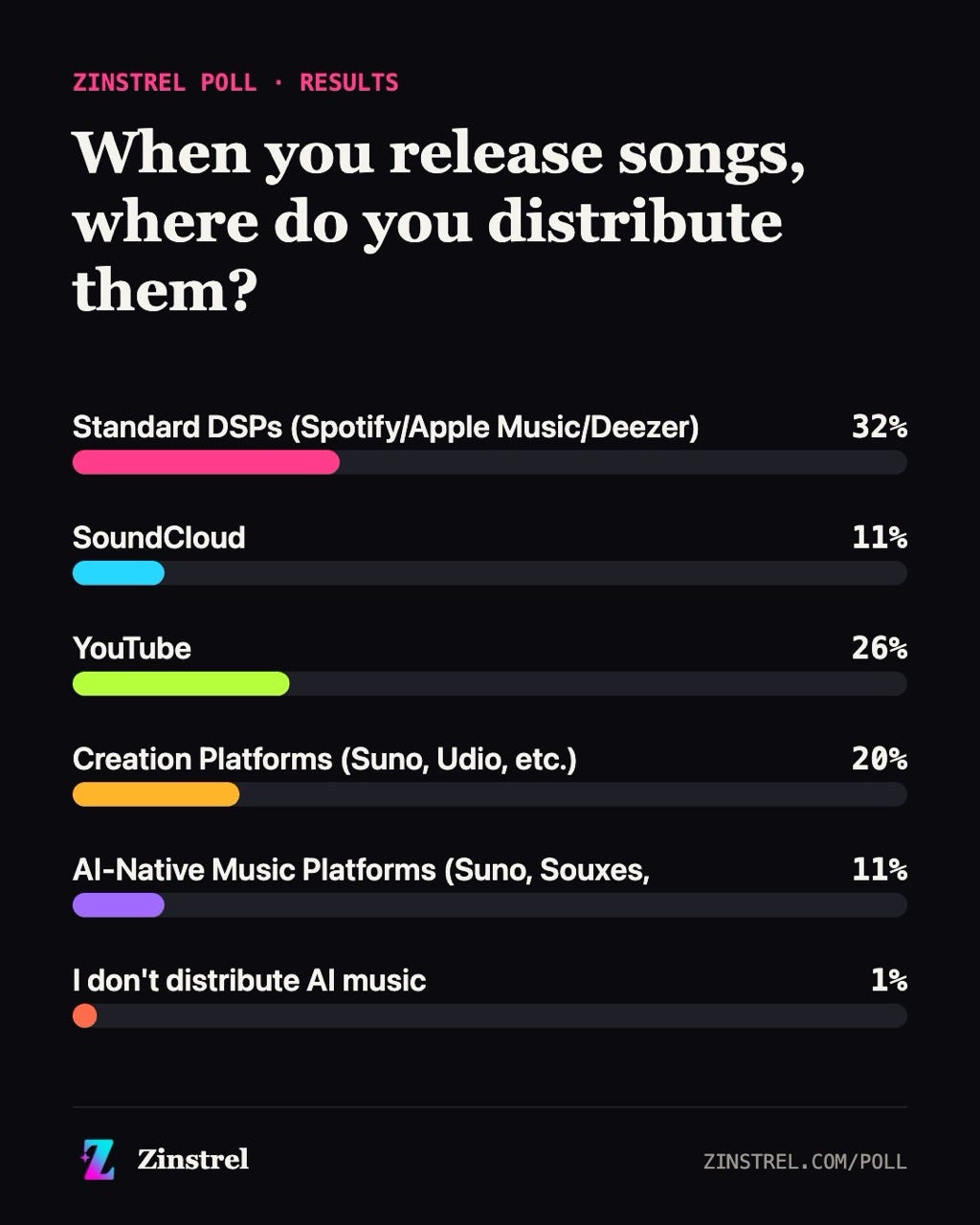
➡️ Take this week’s poll, which asks: What’s the biggest threat to AI music creators right now?
MORE SIGNALS
YouTube Music Adds AI Labels. Deezer Adds an Off Switch.
YouTube Music began rolling out AI labels on Oct. 14 for tracks created primarily with generative AI. The labels appear directly on the player, with a tap revealing more information, and will expand to the main YouTube app. YouTube says it uses partner disclosures and its own detection tools to identify tracks.
Deezer is taking filtering a step further: before year-end, listeners will be able to hide fully AI-generated tracks, albums, and related artists from search results. Deezer already excludes detected AI-generated music from recommendations and editorial playlists. For AI creators, these policies increasingly shape whether listeners encounter their music—and what they know when they do.

Goldman Predicts $3.3 Billion a Year From AI Music By 2035
Goldman Sachs’ annual Music in the Air report has put a price on what AI could add to music industry revenue, and on who could lose share. It expects AI music to earn rights holders about $3.3 billion a year by 2035, roughly 10% on top of subscription streaming. That assumes 8% of paid subscribers in major markets pay $11 a month for AI products like licensed creation tools. The downside is dilution. Goldman warns that millions of AI tracks could pull royalties from human-made catalog, especially in lo-fi, sleep, and study music. That tension shapes its picks. It broadly favors streaming platforms like Spotify and Tencent, which earn no matter who made the tracks, over rights owners.
AI-Voiced Ballad Reaches No. 3 on Melon
Meomuru’s “The Adult I Dreamed Of,” a June rock ballad whose melody and vocals were generated on Suno, climbed from No. 18 to No. 3 on the Top 100 of Melon — South Korea’s largest streaming service — between Oct. 2 and 13, Korean outlets report. That’s the highest an AI-sung track has reached on the country’s dominant streaming chart. Meomuru wrote the lyrics and calls AI “a modern instrument and partner.” Melon doesn’t label the song as AI, but YouTube does. According to My Daily, the song cleared karaoke distribution only after its creator agreed to forgo royalties.
Sweden’s Eurovision Prelim Won’t Ban AI Songs
Melodifestivalen, Sweden’s national selection for Eurovision, drew a record 4,077 submissions for 2027, and broadcaster SVT expects some were made with AI. It isn’t banning them, and it doesn’t run detection software. Project manager Anders Wistbacka said SVT will follow the music industry’s lead, and called a fully AI winner unlikely because every song still needs a live performer. That’s a quiet green light for AI in the writing room, and the opposite of Greece, where Sing for Greece 2027 banned AI outright.

AI-Made Russian War Songs Slip Past Platform Filters
Terrecon, a Kyiv-based threat-intelligence nonprofit, has catalogued 981 AI-generated songs carrying pro-Russian war propaganda across Spotify, Apple Music, YouTube, and Deezer, collectively drawing millions of streams, The New York Times reported. Only Deezer flagged them as AI. Terrecon also prompted Suno, Udio, Google Flow Music, and Mureka to write similar songs. Some prompts were refused, but others went through, and the test tracks made it onto YouTube Music and SoundCloud. Filters caught banned words, not meaning. YouTube labeled several songs and removed one test track after the Times asked. We talked about AI music’s role in propaganda back in May.
GRAI Licenses Music for Streaming and AI Training
GRAI, the AI music startup building a social streaming service, has signed two deals with Songtradr’s MassiveMusic. One supplies the catalog for its upcoming app, with rightsholders paid and sent usage reports for plays. GRAI says the other licenses an opt-in dataset, approved by rightsholders specifically for AI training, for its in-house music model. CTO Dzmitry Kamarouski calls the approach “rights before code.” It’s the latest licensing move for GRAI, which acquired Hangout, the Turntable.fm creators’ platform, in September — and is one of the first two companies to license Music IP Holdings’ AI patents.
Suno Lets Collaborators Share Custom Models
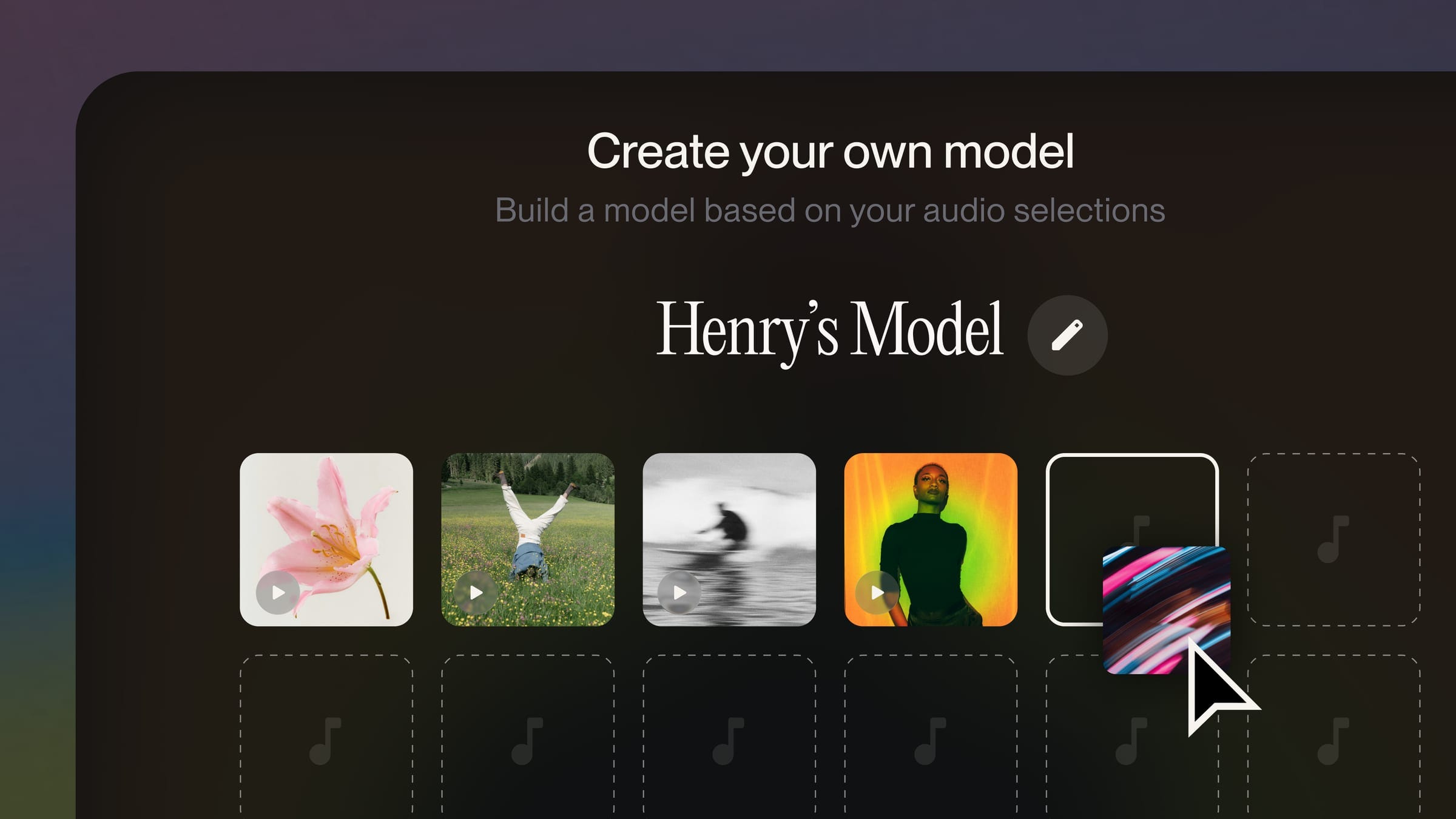
Suno has added two collaboration features. Shareable Workspaces let Pro and Premier subscribers share a song library with invited teammates. More notably, Premier users can now share Custom Models — the personalized versions of Suno trained on a user’s own catalog. When Custom Models launched with v5.5 in March, they were strictly private. Suno says the models now accept twice as many inputs, too. It’s a real shift. Until now, a Custom Model only made music for the person who trained it. Now it can serve a whole team, which raises the stakes on Suno’s rule that people may only train on songs they own.
🛠️ Updates & Releases
discoDSP released WavePrompt, a free offline text-to-music app for macOS and Windows built on the YuE2 model. It makes songs up to four minutes long and exports MIDI.
Daydream previewed AI auto-mixing in its browser-based Studio. For now it only balances track levels.
Overkill, a VST3, AU, and AAX plugin, turns a text prompt into a working effect inside the DAW. Creator Connor Panayi announced it on LinkedIn. No release date yet.
ACE Studio retired its legacy Basic and Creator plans on Oct. 15, and converted members’ remaining days one-for-one into its Artist plan.
Distraction Media launched Distraction Music, an open-source player for indie discovery with charts, playlists, a Discovery Radio stream, and verified artist profiles.
Anthem.fm just rebranded to Tuneria, offering a French-language, 24/7 community radio for AI music built by a single developer. Creators earn the right to publish by listening to and reacting to other people’s tracks.
🎧 Song of the Day: “Silent Song” by Zonne
Dutch singer-songwriter Zonne was announced on Oct. 15 as the top vote-getter in the Zinstrel Challenge, Presented by ElevenMusic. Her winning entry, “Silent Song,” was the result of a songwriting exercise that led her to pen the tender acoustic refrain about feeling invisible. She won $1,000 from ElevenMusic, plus three months of ElevenMusic Pro.
👀 Want to be our Song of the Day? Submit your release to Zinstrel.
💬 Last Word
“Every musician starts with influences. The interesting part is what happens when those influences become something new.”
— Bob Pfeifer (CEO of BandM8), in his published conversation with Serge Belongie, Professor of Computer Science at the University of Copenhagen

MORE ZINSTREL:
Zinstrel.com | @zinstrelculture on IG | AI Underground on Discord
Zinstrel #128 (Frame): ‘Monster Mash’ Was the Original AI Slop
Zinstrel #127 (Culture): Mentorship, Meetups, and Music Videos: Samori Coles Is Just Getting Started
Created by Marcus Lawrence
Copyright 2025-2026 Zinstrel, LLC - All rights reserved
Special thanks to our paid subscribers: Blue Hermit, Bukar Gadzama, C.Y. Lee, Charles S, Chez, Daniel Drolet, Daryl Dekking, Dave, Dexter Garcia, Drew Thurlow, Ghost Ryder, Itai Leibowitz, Jacci Cenci-McGrody, Lenny Skolnik, Lynn Clapp, Marc Wolinsky, Matthew Marturano, Matti Kuha, Mete Dibi, Rosanna, Sheila Spence, Steve Clapp,
Steve Grossman, Tim Burley, and Tracy Maddux.
Disclosures: Marcus Lawrence serves on SIQA's Creative Advisory Council.
The Zinstrel Challenge is presented by ElevenMusic, from ElevenLabs.