

AI Record Labels Are Proliferating. But What Are They?
Zinstrel #067 · Culture · AI Music News & Analysis

Are record labels even necessary anymore? That’s been the question hovering over the music industry for the past decade, as production, distribution, and marketing have become easier than ever for artists.
It’s easier than ever to be an independent artist — and arguably even easier to invent entire personas with AI music tools. Now, a new phenomenon is forming around that possibility: AI record labels full of AI artists.
This isn’t Warner’s Spinnin’ Records backing a Suno-assisted artist. These are scrappier operations being built from scratch by charismatic creators inside the space. Some present like modern entertainment companies. Some are passion projects. All of them are figuring out what they are while they build.
So far, two models are emerging: one creator with many personas, and one label with many creators. In both cases, the AI record label is less a financial or distribution umbrella than a cultural one — a place to house spiritually connected projects, each trying to make its own mark on the music landscape.
Here’s how both models are starting to take shape.
One Creator, Many Personas
For many AI music creators, the label is a way to house their multiple AI personas — managing the full stack from music to visuals to social presence.
The closer analogy isn’t a record label — it’s an IP studio. Like Disney, Marvel, or Nintendo, they’re building empires around unique characters rather than individual actors. The character-building functions — design, story, world, merch — are central; traditional label functions are secondary or absent.
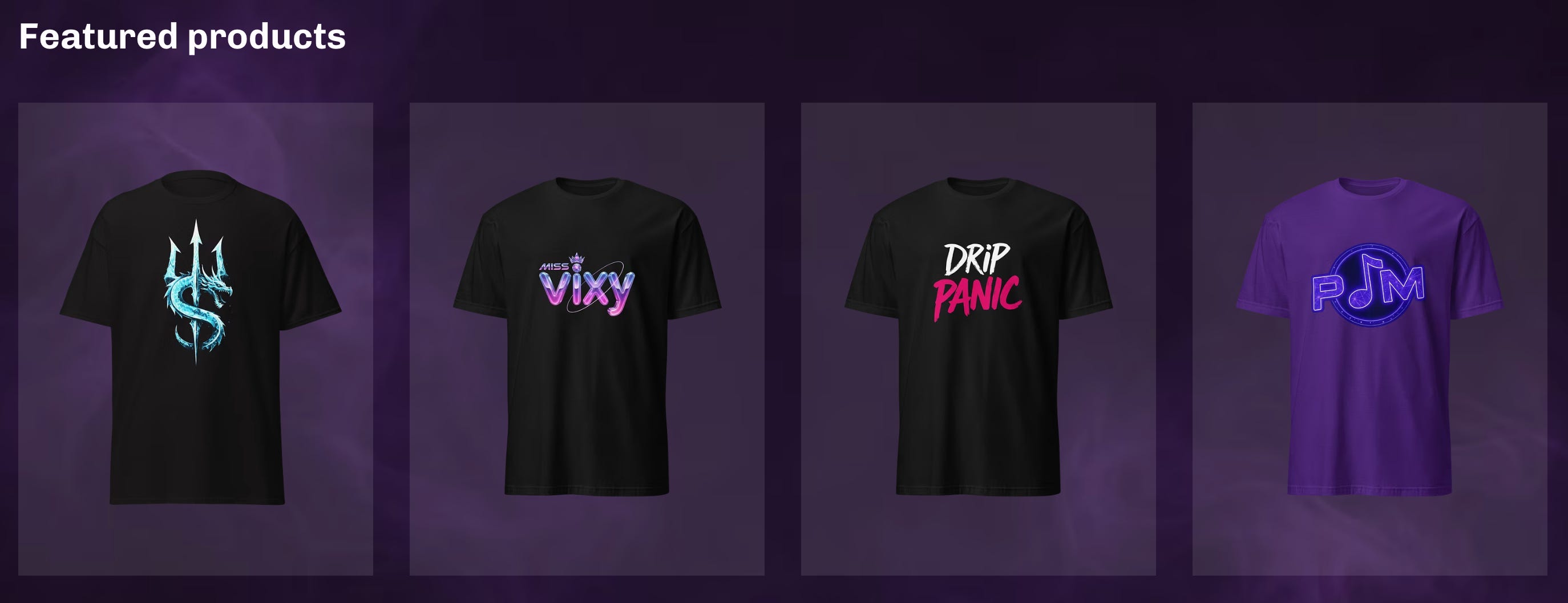
Bobby “Professor Jacket” Clark runs Professor Jacket Music with eight personas — Professor Jacket, Madisynn, Colton Lynch, Miss Vixy, The Sirens, 1sev7n, NocVyre, and Drip Panic — each with their own backstory, lane, and aesthetic. He calls PJM a creative label, inspired by Detroit’s Psychopathic Records (which spawned Insane Clown Posse, among other mythologized acts).
“Each artist is designed to feel memorable, distinct, and emotionally recognizable,” Clark says. “The roster reads less like a playlist and more like a cast list.”
And the fandom goes beyond just listening to the songs; he says he makes more money from his artists’ merch than he does streaming payouts.
Ryan Caplinger runs RyRy Records, which started a year ago with one AI artist, Aria, and has since expanded to fifteen acts spanning different sounds, aesthetics, and identities. Caplinger builds each one from the ground up — songs, signature colors, album covers, photo shoots, social presence.
“Every artist gets the full treatment, like they’re real people stepping into the spotlight,” he says.
WindWaterCloud pushes the model even further through his Melodelight Studios, where he says he has created about 30 personas. He monetizes mainly through YouTube and DistroKid, but the more interesting part is how he keeps the operation coherent. Each persona has its own overarching storyline, and because he works in the film industry, creating backstories comes naturally.
“It’s a multiverse,” he says, with many of the personas aware of each other so collaborations can move larger story arcs forward. He is also part of VillAIns, a nine-creator collective that began as a concept inspired by supervillain archetypes before expanding into a shared creative universe with its own mythology, characters, and world building.
Kai Shadrix runs Parallax House with four personas: Kai Shadrix (cyberpunk EDM), Kingsley Wolfe (pop EDM), Vane Kross (K-pop), and Alessandro Rossi (multilingual global tech pop). He says he doesn’t consider what he’s doing a “label” — yet.
“Right now it’s more of a creative studio and artist-development project,” he says. “If it grows successfully, I’d definitely be open to signing other artists in the future.”
The resistance isn’t vocabulary skepticism — it’s protective. To him, “label” means signing other people, and he hasn’t done that yet.
The thesis all of these creators share is almost identical: they’re building artists, not songs.
“AI music was never just about generating songs,” Clark says. “It was about creating stars.”
One Label, Many Creators
We told the story of Romel Murphy’s Chicago-based firm, dai+drm, which is assembling a roster of SIQA-charting artists like Xania Monet, Solomon Ray, and Proph3ci.
dai+drm represents perhaps the best-known example of the other side of the emerging AI record label category. Instead of one creator building many fictional acts, it’s one operation gathering multiple artists under a professional umbrella.
That’s the bet: AI music at scale may not look like a lone prompt-writer spinning up personas forever. It may look like a curated roster of established acts, run on management infrastructure, contracts, and release discipline. And a growing group of AI labels is chasing some version of that same idea.
They’re signing outside talent, building rosters, and treating the AI part as incidental to the structure underneath.
DJ Sev runs Severed Fate Records, a nine-artist roster including DJ_Sev & The Darkness, MissEkco, Valentyna Volkov, and Otakaijin.
“We don’t explicitly treat it as AI-only,” Sev says. “It’s just how it fell for us.”
Severed Fate works only with people Sev knows personally, and the contracts, he says, are “set up to benefit the artist, not so much to profit from their content. We studied the analog music industry and the shady ways in which labels have controlled artists is not something we are fond of.”
AI artist The Demon Doctor runs Wrath Ring Records, which has a decidedly hybrid label approach. Most of Wrath Ring is fictional characters he creates himself — Roxy Blackwell, Cassidy Renae, Mira Vale, 404 PARAD0X — but one artist, Avescrion, is a real human he found at a Discord listening party. He’s doing A&R in the traditional sense alongside the persona-studio model.
“What I aim with all this is to break the common narrative that all AI is slop,” he says.
Dystopia Music Group is the most professionalized of the set. Its Instagram bio describes the company as “a Full Service Independent Hybrid Label Management Group.” Founder Sherman Trotz comes from a visual-creator background, with more than 50 million views across his platforms. Dystopia’s recruitment posture is direct: “AI isn’t replacing creativity — it’s exposing who actually has it. If you’re a hybrid artist using AI as a tool, not a crutch, this is your lane.”
And finally, Resonant Records frames itself as “a forward-thinking creative collective.” Founded in January by Jaiden Shields, it has a roster of about ten real artists — including Jai The Poet, Poppa Dom, Doc Doobie, and Fresh Friday Festival host Fenix — working across music, video, comic books, and games. It’s one of the most collective-minded operations in the space, treating the label less as a business structure than as a shared creative home.
The Future Is Being Written
Like many aspects of AI music culture, there’s no set definition yet of what an AI record label even is. It’s being built in real time, mostly through the vocabulary choices these operators are making — label, studio, collective, modern entertainment company, anti-exploitation indie, persona-studio. Same activity, several different words for it.
What’s clear is that the people building these operations aren’t waiting for permission or precedent. They’re testing what a label can be when the artists are personas, the rosters are fluid, and the infrastructure is whatever the founder decides to build.
Whether the result ends up looking more like Sub Pop, Marvel, or something we don’t have a name for yet, the shape of it is being decided right now — by the creators willing to call themselves labels before anyone else does.
💿 SIQA Top AI Songs of the Week
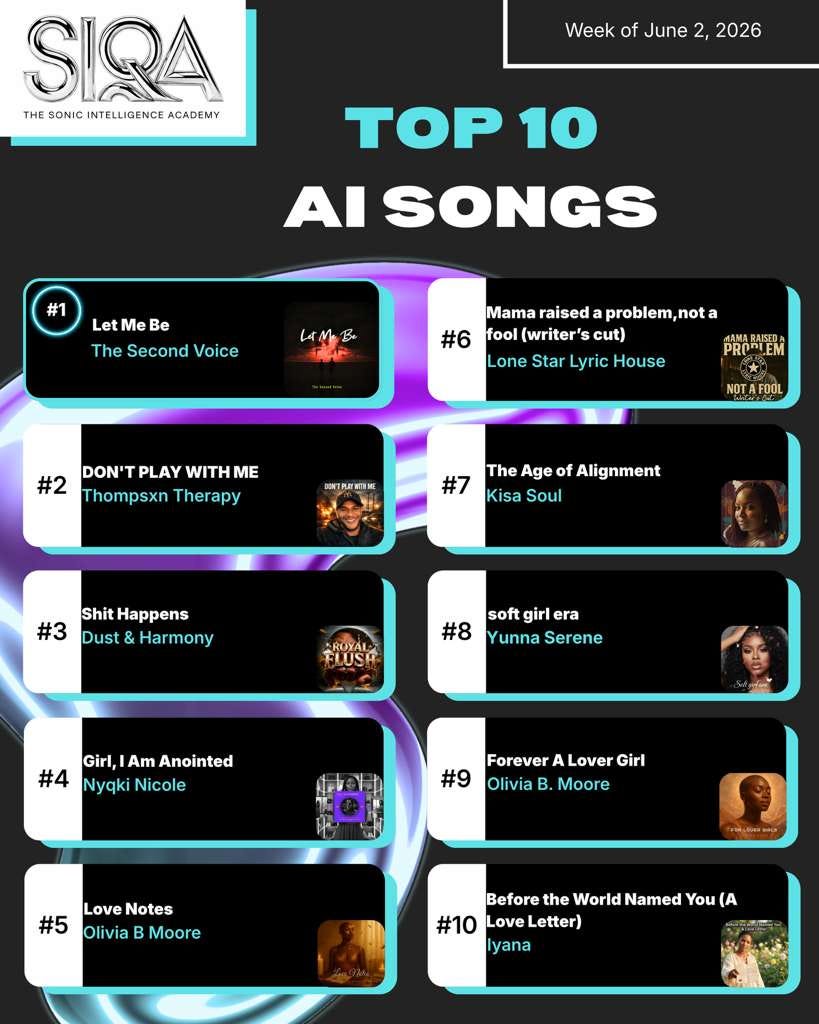
After falling to No. 5 last week, former No. 1 Thompsxn Therapy has climbed back to the No. 2 position, but the overall streams of “Let Me Be” will be hard to overtake.
🎧 Song of the Day: “RIPtide” by The Sirens
Equal parts rock anthem and sea shanty, this Professor Jacket Music joint follows the mythology of sirens calling sailors to their doom with distorted guitars and a double kick drum.
💬 Last Word
“Expensive studios and large production systems were not proof of artistic truth. They were often just the technological and economic constraints of their time.”
— AY Sound Works Founder/Producer Akihisa Yorozu, via LinkedIn

MORE ZINSTREL:
Zinstrel.com | @zinstrel_ai on IG | AI Underground on Discord | Culture Vision TV
Written by Marcus Lawrence, courtesy of composition platform Versey.ai.
I use em dashes proudly.
Special thanks to our paid subscribers: C.Y. Lee, Daryl Dekking, Lynn Clapp, Steve Clapp, Mete Dibi, Daniel Lares, Dexter Garcia, Matthew Marturano, Sammy Stoltz, Tim Burley, Drew Thurlow, Sheila Spence, Lenny Skolnik, Màuhan Zonoozy, and Matti Kuha.