



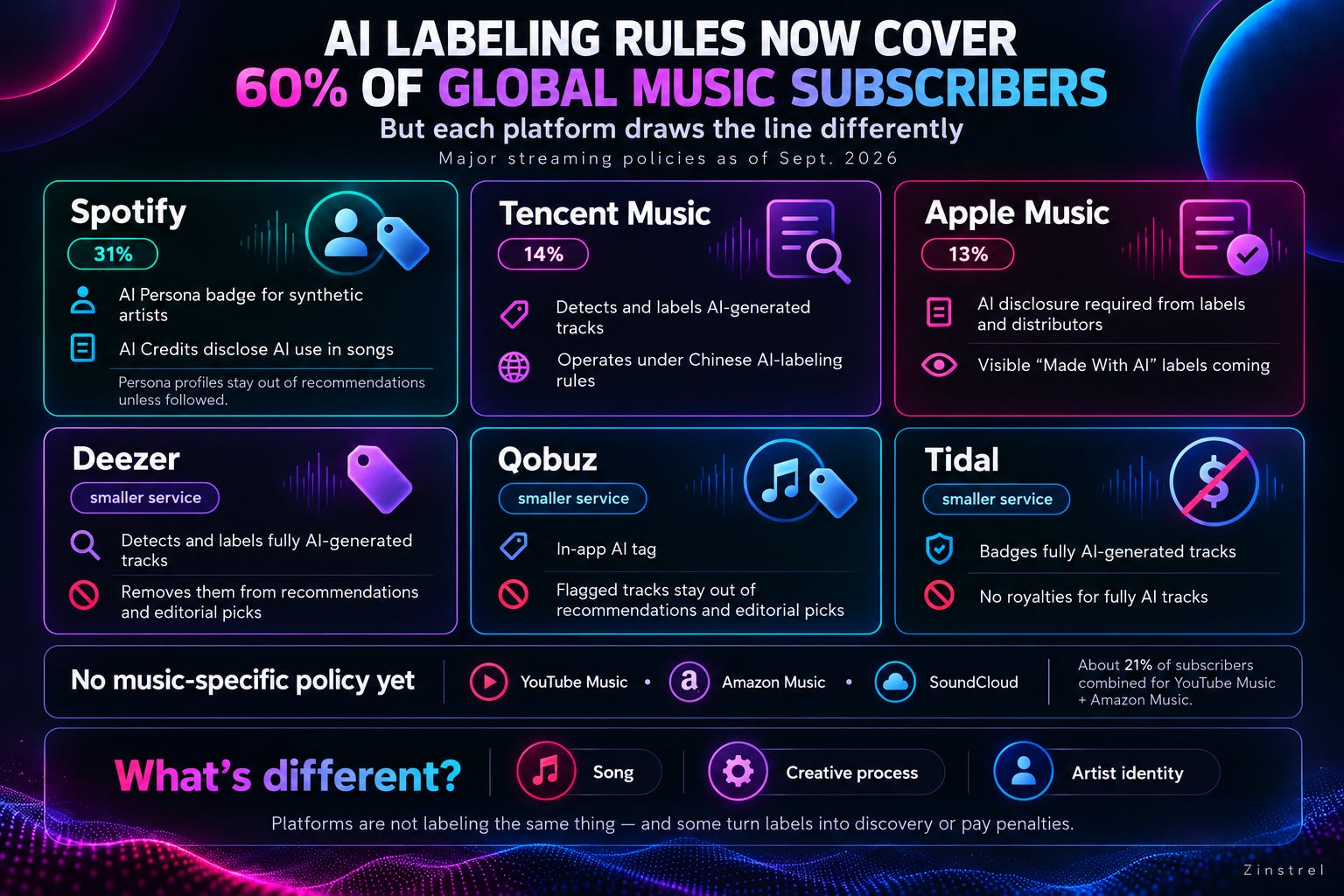
With Qobuz’s Sept. 24 rollout of an in-app AI tag, services holding about 60% of the world’s paid music subscribers now have AI labeling policies, based on MIDiA Research’s year-end 2025 figures. But each draws the line differently.
Market leader Spotify — representing 31% of subscribers — labels people, not just songs. Its new AI Persona badge keeps AI-generated artist identities out of recommendations unless listeners follow them, while AI Credits let artists disclose AI-generated vocals, lyrics, instrumentation or production. China’s Tencent Music (14%) detects and labels AI tracks amid Chinese rules requiring AI-generated online content to be identified. Apple Music (13%) made AI disclosure mandatory for labels and distributors Aug. 20, with listener-facing “Made With AI” labels arriving soon.
The strictest rules sit at the smallest services. Deezer and Qobuz run their own detection and pull flagged tracks from recommendations, and Tidal pays fully AI tracks nothing. YouTube Music and Amazon Music, about 21% combined, have no music-specific labeling policy, and neither does SoundCloud — which is steadily becoming a destination DSP for AI creators.
The streamers say the targets are fraud farms, bulk-generated catalogs, impersonators and synthetic personas. In practice, regular creators making music with AI tools can lose discovery, and even the ability to monetize — fraudulent or not.
That puts creators in a bind. Listeners overwhelmingly say they want labels in survey after survey. But a peer-reviewed study found that music labeled as AI produced less engagement, even when the music itself was human-composed. Many creators now have to decide if, when and how to self-identify.
Some have made peace with it. On AI-native platforms like Souna, FreeMusiers, Sone.fm, Souxes, HLYLAB, and UpChart, the AI label is the point, not a penalty. But those are niche safe havens, not the general-market portals where most listeners find music.
The label is becoming the default across most of the market. What it means, information or penalty, is still being hashed out.
👀 Poll of the Week Results
Universal Music Group has sued DistroKid for how it handles AI music distribution. Deezer and Qobuz both decry the amount of AI music hitting DSPs. LANDR sees distribution as the most important way to prevent fake streams. So — how does the Zinstrel community see it?
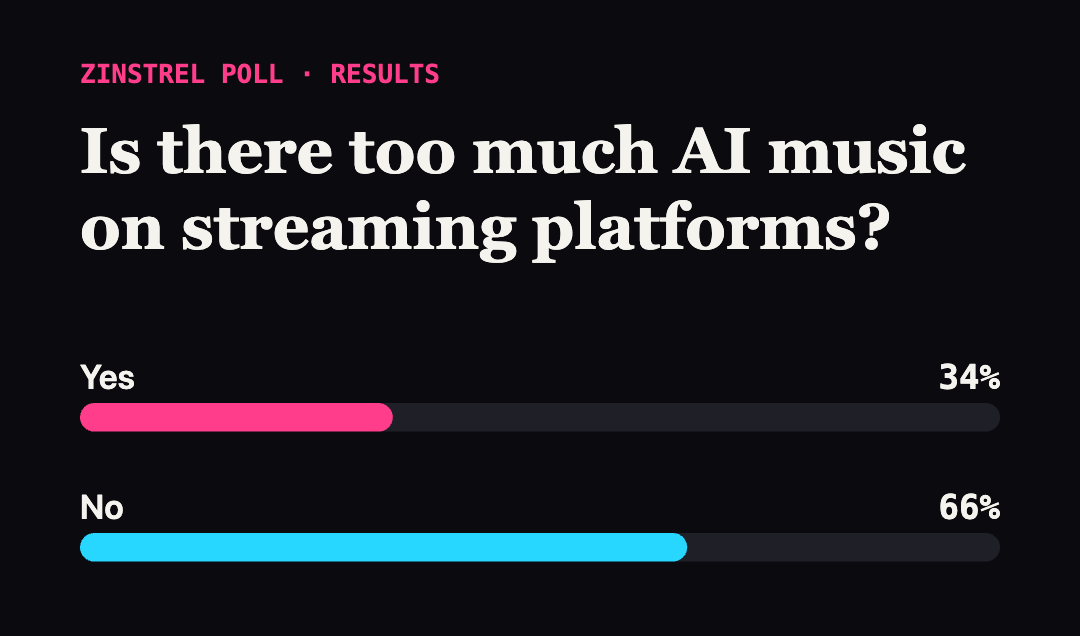
➡️ Take this week’s poll, which asks:
Generally speaking, when you make AI music, how do you handle lyrics?
MORE SIGNALS

Snapchat Turns Chat Messages Into AI Songs
Snapchat has launched Chat to Song, which turns a message into a short original track. Users press and hold a message, pick a genre, preview the result and send it back into the conversation. It’s limited to paying Lens+ subscribers, and generations can be blocked by safety checks or daily and rate limits. Snap’s promo images show an “AI Song” label on generated tracks, but it hasn’t said whose model powers the feature or what it was trained on.
HUGEL Opens the Project File on His AI-Born Hit
HUGEL’s “Movin’ To The Sun,” with Imael Angel and Ultra Naté, hit No. 1 on Beatport and spent 16 days atop Shazam’s global chart, yet listeners kept asking if it was AI. HUGEL answered with a studio breakdown, showing Imael Angel’s original Suno demo, the production he rebuilt around it, Ultra Naté’s recorded lead and, beneath it, the earlier AI vocal that was never fully removed. It’s exactly the kind of hybrid record today’s labels struggle to classify, and better release content than any caption insisting a song is human-made.
Suno Starts Teaching Its Users to Mix
Suno launched a production-education series on its blog, starting Sept. 22 with what a compressor actually does, from threshold and ratio to why compressed audio sounds louder. EQ is next. The series follows Studio 2.0, which added a number of built-in effects Aug. 13, and the post stresses compression for uploaded or recorded audio. A generator known for finished songs is now teaching subscribers to mix them.
AI-Made Songs Are Turning Up in Grief and in Court
Two stories this week show how ordinary AI songwriting has become, even in life’s darkest moments. In Smiths Falls, Ontario, metalworker Rob Carr used Suno to build “Kelly-Jordan Road,” a tribute to three men whose remains were found on the same rural property. Carr was upfront that it was AI, and it still brought many in the community to tears, including one victim's family, the Ottawa Citizen reports. Meanwhile, Ohio prosecutors played two AI-produced songs in the murder trial of former American Idol contestant Caleb Flynn, charged with killing his wife, presenting the tracks — reportedly written for his mistress — as insight into his state of mind. According to 404 Media, Flynn said he wrote the lyrics and melody himself before running a rough vocal through an AI music tool. Personal songs once rare are now everywhere, including the public record.

WAV-R Social Rebrands as HLYLAB
WAV-R Social, the Norway-based AI music network that grew from track sharing and internet radio into production tools and a browser-based DAW, is rebranding as HLYLAB, short for “Hear · Link · You.” The team says the platform has outgrown being “another music platform,” expanding toward artists, fans, community, discovery and technology. Accounts, content and history carry over, and old WAV-R links will redirect to hlylab.no over the next week. For an indie platform and another Zinstrel 100 name, a broader identity leaves room to grow.
Enter Your Songs by 11:59 p.m. PDT in the Zinstrel Challenge
The Zinstrel Challenge, Presented by ElevenMusic, is taking submissions through 11:59 Monday, Sept. 28. Eleven finalists will face off in a ranked-choice bracket, with $1,000, $500 and $250 cash prizes and three months of ElevenMusic Pro for the winners, plus Zinstrel features. The finale streams live Oct. 15. Enter here.
🎧 Song of the Day: “Smells like death” by AfterVoice
AfterVoice’s “Smells like death,” representing the United Kingdom, won Afterglow 2026, the remix edition of the European AI Song Federation’s EuroReVision Contest, when voting closed Sept. 26.
All 401 entries reworked the entrants’ own earlier songs. Barcelona creator Jaime remixed his Spanish “Huele a muerto” into an English adaptation of Emily Dickinson’s “I felt a Funeral, in my Brain,” a meditation on losing your identity by handing your thinking to AI, ending as the vocal dissolves into glitches. EuroReVision, a Zinstrel 100 name to know, isn’t affiliated with Eurovision — but is certainly inspired by it.
👀 Want to be our Song of the Day? Submit your release to Zinstrel.
💬 Last Word
“It appears to me we’ve started focusing on the wrong part of the conversation. Too much attention is being placed on whether something was written by AI or by a human. I’m more interested in what came out the other end. Is the idea any good? Is it useful? Does it make you think? Is there judgment behind it?”
— James Richman (Founder & CEO, TimeLess Essence), via LinkedIn

MORE ZINSTREL:
Zinstrel.com | @zinstrelculture on IG | AI Underground on Discord
Zinstrel #119: What the West Can Learn from China’s AI Remix Platforms
Zinstrel #118: The Udio Remnant
Created by Marcus Lawrence
Copyright 2025-2026 Zinstrel, LLC - All rights reserved
Special thanks to our paid subscribers: Blue Hermit, Bukar Gadzama, C.Y. Lee, Charles S, Chez, Daniel Drolet, Daryl Dekking, Dave, Dexter Garcia, Drew Thurlow, Ghost Ryder, Itai Leibowitz, Jacci Cenci-McGrody, Lenny Skolnik, Lynn Clapp, Marc Wolinsky, Matthew Marturano, Matti Kuha, Mete Dibi, Rosanna, Sheila Spence,
Steve Clapp, Steve Grossman, Tim Burley, and Tracy Maddux.
Disclosures: Marcus Lawrence serves on SIQA's Creative Advisory Council.
The Zinstrel Challenge is presented by ElevenMusic, from ElevenLabs.
Really glad to see my track featured as Song of the Day. Thank you so much for the support and for highlighting the EuroReVision contest.
Best,
Jaime (AfterVoice) 🙂